

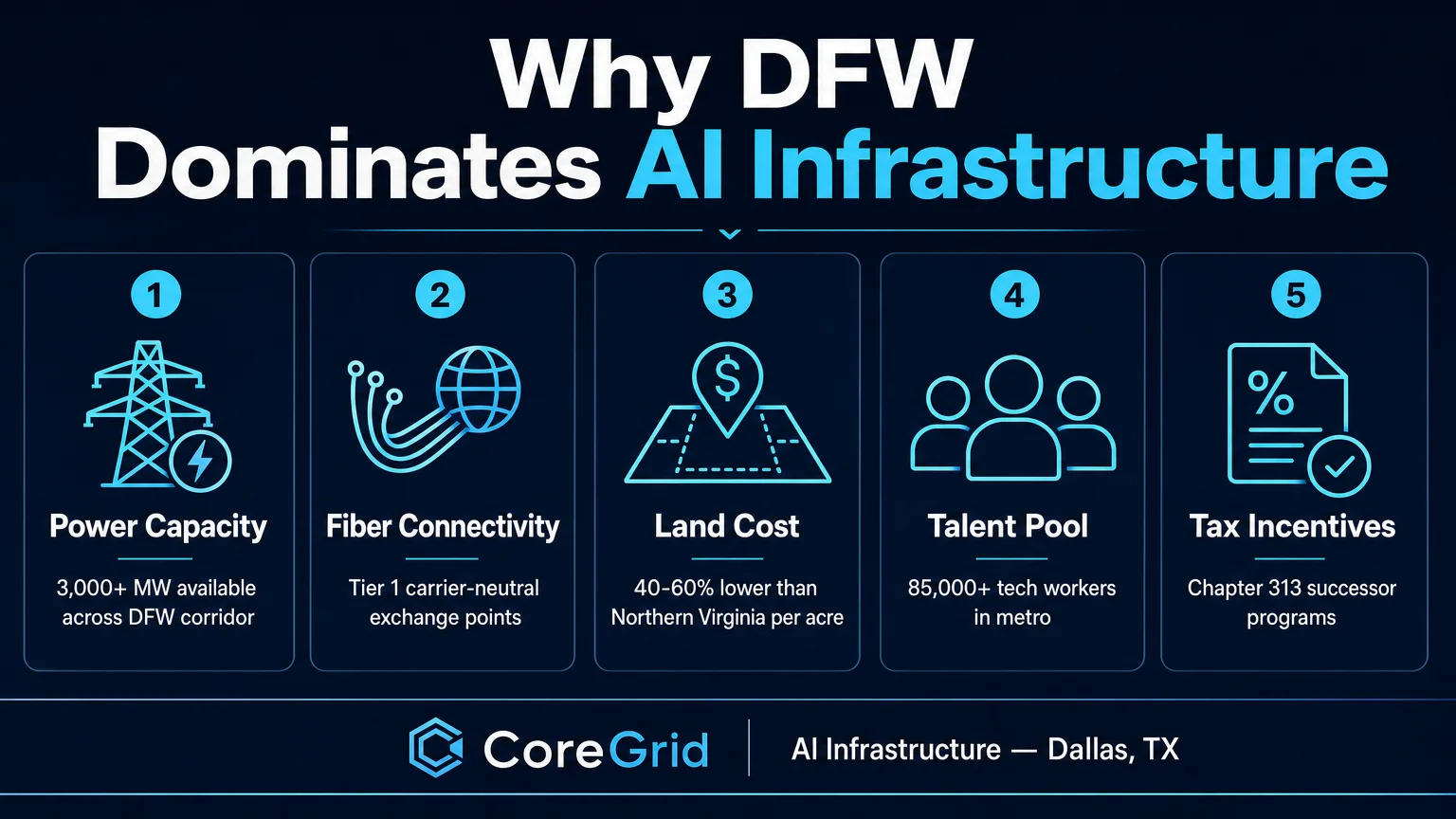
More than 60 hyperscale and colocation data center projects were announced or under construction across the Dallas-Fort Worth metroplex between 2023 and 2025 — a volume that rivals Northern Virginia and exceeds most other U.S. markets combined. That concentration of capital and capacity is not coincidental. DFW has assembled a specific combination of power access, fiber density, favorable economics, and workforce depth that makes it one of the most compelling regions for AI infrastructure deployment in the country.
Key Takeaways
- Dallas-Fort Worth has emerged as a Tier 1 data center market, competing directly with Northern Virginia, Silicon Valley, and Chicago for AI infrastructure investment.
- The region’s power grid access, land availability, and lower cost basis compared to coastal markets give it a structural cost advantage for GPU-dense deployments.
- DFW sits at a major fiber crossroads, with multiple Tier 1 carriers and carrier-neutral exchange points providing low-latency connectivity across North America.
- Texas’s business-friendly regulatory environment and available tax incentive structures reduce total cost of ownership for long-term infrastructure commitments.
- A growing local talent pool in engineering, networking, and cloud operations supports ongoing data center operations at scale.
- The region supports a wide range of workload types — from large-scale AI training clusters to edge inference deployments serving the South-Central U.S.
- Companies evaluating AI data center site selection should treat DFW as a primary candidate market, not a secondary fallback.
What Makes Dallas-Fort Worth a Compelling AI Infrastructure Market?
Dallas-Fort Worth qualifies as a top AI infrastructure market because it combines three factors that are rarely available together: abundant power capacity, competitive real estate costs, and carrier-grade fiber density. Most coastal Tier 1 markets offer fiber and talent but face severe power constraints and land scarcity. DFW offers all three simultaneously, which is why hyperscalers, GPU colocation providers, and enterprise IT teams have accelerated their presence in the region.
The market also benefits from geographic centrality. A data center in the DFW corridor can serve both coasts with latency profiles that are acceptable for inference workloads, making it a practical hub for companies that need national reach without operating in multiple high-cost markets simultaneously.
How Does DFW’s Power Infrastructure Support High-Density AI Workloads?
Power availability is the single most constraining factor in AI infrastructure planning, and DFW’s position on the ERCOT grid gives it a meaningful advantage. The Texas grid has historically supported large industrial and commercial power consumers, and the DFW corridor has developed a significant pipeline of substation capacity and transmission infrastructure capable of supporting multi-hundred-megawatt data center campuses.
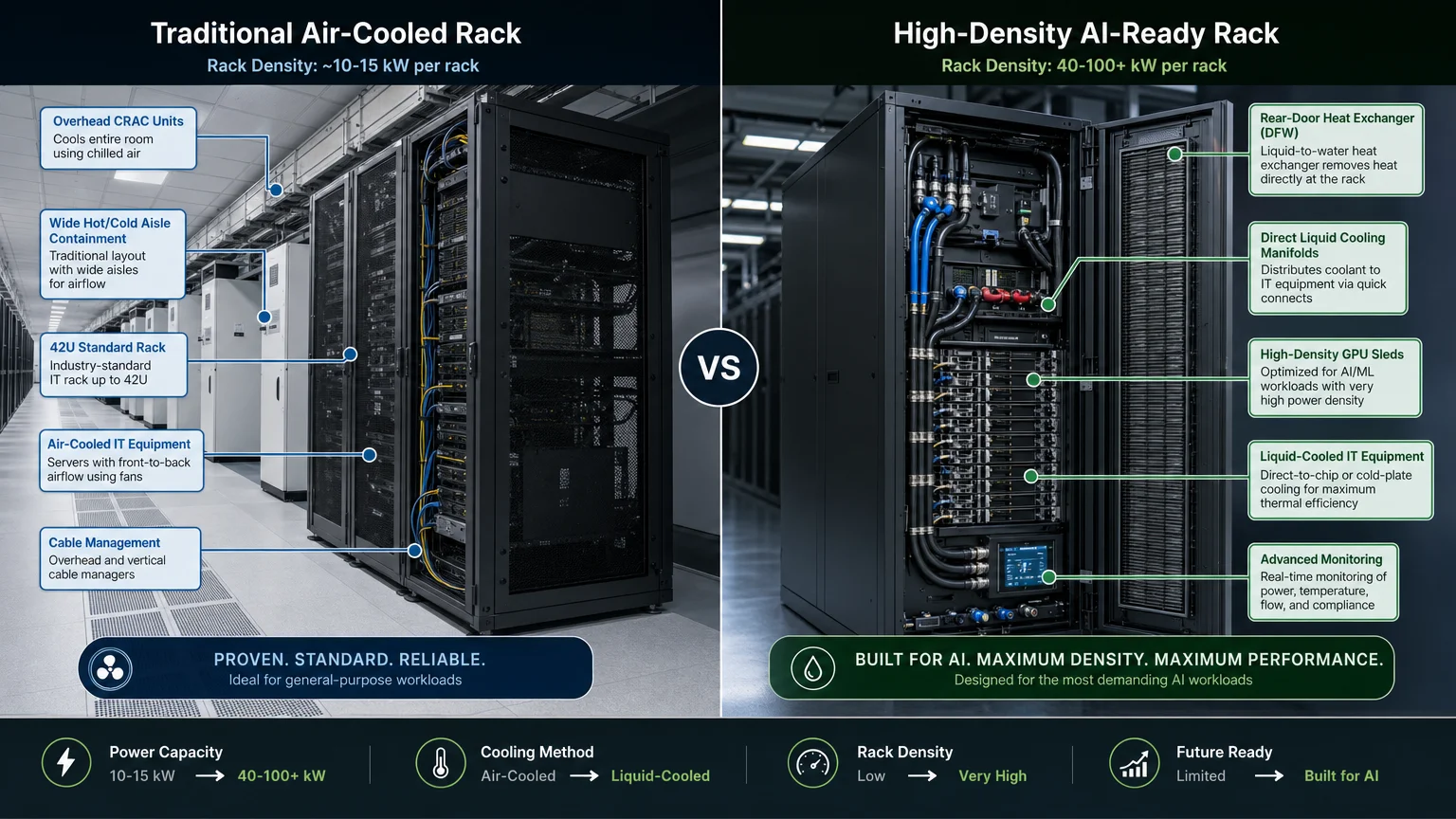
Modern AI training clusters — particularly those running dense GPU configurations — require power densities of 40 to 100+ kilowatts per rack, compared to 8 to 15 kilowatts for traditional enterprise workloads. DFW colocation providers have responded by developing purpose-built AI-ready facilities with liquid-cooling infrastructure, high-amperage power distribution, and generator backup systems sized for these demands. For companies conducting AI data center site selection in Dallas, power readiness is typically the first filter applied — and DFW passes it consistently across multiple submarkets including Garland, Irving, Allen, and Plano.
Why Is DFW’s Fiber and Connectivity Infrastructure Relevant to AI Deployments?
AI infrastructure is not purely a compute problem — it is also a data movement problem. Training pipelines require high-throughput ingestion from distributed data sources. Inference deployments require low-latency response to end users. Both demands are well-served by DFW’s position as a major fiber interchange.
The Dallas area hosts carrier-neutral exchange points that aggregate traffic from multiple Tier 1 providers, enabling colocation tenants to access diverse network paths without relying on a single carrier. This redundancy matters for AI applications where network interruptions can disrupt distributed training jobs or degrade inference service levels. Companies comparing DFW against secondary markets should factor in not just raw bandwidth pricing but path diversity and the availability of direct interconnects to cloud on-ramps for AWS, Azure, and Google Cloud — all of which maintain regional presence in the DFW area.
How Do DFW’s Economics Compare to Other Top AI Infrastructure Markets?
The cost differential between DFW and the two legacy Tier 1 markets — Northern Virginia and Silicon Valley — is substantial. Land costs in the DFW corridor run 40 to 60 percent lower per acre than Northern Virginia submarkets like Ashburn and Manassas. Power rates in Texas, while variable given ERCOT’s market structure, have historically been competitive with Mid-Atlantic rates for large commercial consumers with demand-response agreements in place.
Colocation pricing in DFW reflects this cost basis. Wholesale power and space rates for high-density deployments are generally more competitive than comparable configurations in Northern Virginia or the Bay Area, though pricing varies significantly by provider, contract term, and density tier. For a detailed market comparison, CoreGrid’s analysis of Dallas vs Phoenix for AI data center deployment in 2026 illustrates how DFW stacks up against another fast-growing Sun Belt competitor across multiple cost and capacity dimensions.
| Factor | DFW | Northern Virginia | Silicon Valley |
|---|---|---|---|
| Land Cost per Acre | Lower | High | Very High |
| Power Rate Competitiveness | Competitive | Moderate | High |
| Available Capacity (2026) | High | Constrained | Very Constrained |
| Fiber Density | High | Very High | Very High |
| Incentive Programs | Active | Moderate | Limited |
| AI-Ready Facility Count | Growing Rapidly | Mature | Mature |
What Role Does Texas’s Business Environment Play in AI Infrastructure Decisions?
Texas has consistently ranked among the most business-friendly states for large capital investments, and data centers qualify as exactly the type of long-term, job-creating infrastructure that state and local economic development programs have historically supported. While the Chapter 313 property tax abatement program sunset in 2022, successor incentive frameworks at the county and municipal level continue to provide meaningful relief for large-scale projects.
Beyond formal incentives, Texas’s regulatory environment — including relatively streamlined permitting processes in many DFW municipalities — reduces the timeline from site selection to operational deployment. For AI infrastructure projects where time-to-power is a competitive variable, faster permitting translates directly into earlier revenue generation from deployed GPU capacity.
What Workforce and Ecosystem Advantages Does DFW Offer?
Operating a high-density AI data center requires more than physical infrastructure — it requires engineers, network operations staff, systems administrators, and facilities technicians. The DFW metro area has developed a substantial technology workforce through the growth of corporate headquarters, regional operations centers, and university programs at UT Dallas, SMU, and Texas A&M’s engineering programs.
This talent depth reduces the operational risk of locating critical AI infrastructure in the region. Companies that have already established engineering or IT operations in DFW can extend those teams to support on-premises or colocation-based AI infrastructure without the recruiting friction they would face in smaller markets. For companies planning AI server deployment at scale, workforce proximity to the facility is a practical consideration that often gets underweighted in pure cost analyses.
How Should Companies Approach AI Infrastructure Planning in DFW?
The DFW market’s growth has created both opportunity and complexity. The number of colocation providers, campus locations, and facility types has expanded significantly, and not all options are equally suited to high-density AI workloads. A facility that works well for traditional enterprise IT may lack the power density, cooling infrastructure, or network redundancy required for GPU clusters running continuous training or inference jobs.
Effective planning starts with a clear workload characterization — understanding peak power draw, cooling requirements, connectivity needs, and growth trajectory before engaging with specific providers. CoreGrid’s high-density rack planning process helps clients translate those workload parameters into specific facility requirements, which then drives a structured comparison of available DFW options rather than a reactive response to whatever a single provider proposes.
Companies with operations in other Texas metros should also consider whether a DFW anchor deployment can be complemented by edge nodes in Houston or Austin. CoreGrid supports AI data center site selection in Austin and AI data center site selection in Houston for clients building multi-city Texas infrastructure strategies.
The DFW Opportunity Is Real — and Time-Sensitive
Dallas-Fort Worth’s emergence as a top AI infrastructure market reflects structural advantages that are not going away — but available capacity in the best-positioned facilities does not remain open indefinitely. As hyperscale pre-leasing activity continues and power interconnection queues lengthen, companies that delay infrastructure planning risk facing the same capacity constraints that have made Northern Virginia increasingly difficult to enter.
CoreGrid AI Infrastructure has supported more than 120 data center and colocation projects across 18 U.S. markets, with a particular depth of knowledge in the DFW corridor. If your organization is evaluating AI infrastructure deployment in Dallas-Fort Worth or across multiple U.S. markets, the next step is a structured strategy conversation — not a cold call to a colocation sales team.
Book an Infrastructure Strategy Call with CoreGrid at (214) 555-0196 or reach out at hello@coregridai.com to discuss your workload requirements, timeline, and market options.
Frequently Asked Questions
Why is Dallas-Fort Worth considered a top AI infrastructure market in 2026?
DFW combines high power availability, competitive land and colocation costs, dense fiber connectivity, and a growing technology workforce — factors that are increasingly rare together in mature Tier 1 markets like Northern Virginia and Silicon Valley. The region has seen rapid expansion of AI-ready colocation capacity since 2023.
What power density can DFW data centers support for GPU workloads?
Purpose-built AI facilities in DFW are increasingly designed to support 40 to 100+ kilowatts per rack, which is necessary for dense GPU server configurations. Standard enterprise colocation facilities typically cap at 8 to 15 kilowatts per rack and are not suitable for AI training clusters without significant upgrades.
How does DFW compare to Northern Virginia for AI data center deployment?
DFW generally offers lower land costs, more available capacity, and competitive power rates compared to Northern Virginia's Ashburn corridor, which has experienced significant power constraint. Northern Virginia still leads in raw fiber density and proximity to federal and financial sector customers, but DFW is the stronger option for cost-sensitive AI deployments with national reach requirements.
Does Texas have tax incentives for data center construction?
Texas's Chapter 313 program expired in 2022, but county and municipal incentive programs continue to provide property tax relief and economic development support for qualifying large-scale data center projects. The specific availability and structure of incentives varies by location within the DFW metro.
What types of companies are building AI infrastructure in DFW?
Hyperscale cloud providers, GPU colocation specialists, enterprise IT departments, AI startups, and managed service providers are all active in the DFW market. The region supports both large wholesale campus deployments and smaller retail colocation configurations for companies at earlier stages of AI infrastructure buildout.
What should a company evaluate before choosing a DFW colocation provider for AI workloads?
Key evaluation criteria include available power capacity per rack, cooling infrastructure type (air vs. liquid), network carrier diversity, contract flexibility, expansion options, and the provider's experience with high-density GPU deployments. A structured comparison process is more reliable than relying on a single provider's self-reported capabilities.
Can CoreGrid help with AI infrastructure planning outside of Dallas?
Yes. CoreGrid supports infrastructure planning across 18 U.S. data center markets, including Austin, Houston, Phoenix, Atlanta, Northern Virginia, Chicago, and others. The firm provides vendor-neutral site selection, colocation comparison, and multi-city infrastructure strategy regardless of which market a client ultimately selects.
Contributing writer at CoreGrid AI Infrastructure.