
Atlanta’s Data Center Market: A Site Selection Guide for AI Teams
By 2026, Atlanta ranks among the top five data center markets in North America, with over 1.2 gigawatts of commissioned capacity and a pipeline that continues to outpace most secondary markets. For AI teams racing to secure reliable, high-density compute infrastructure, Atlanta’s Data Center Market: A Site Selection Guide for AI Teams has become one of the most searched and debated topics in enterprise technology circles. The reasons are clear: competitive power costs, deep fiber connectivity, and a business climate that actively courts hyperscale tenants. But navigating this market without a structured approach can cost teams months of delays and millions in avoidable expenses.
Key Takeaways
- Atlanta offers among the lowest commercial power rates in the Southeast, making it a cost-effective choice for GPU-intensive AI workloads.
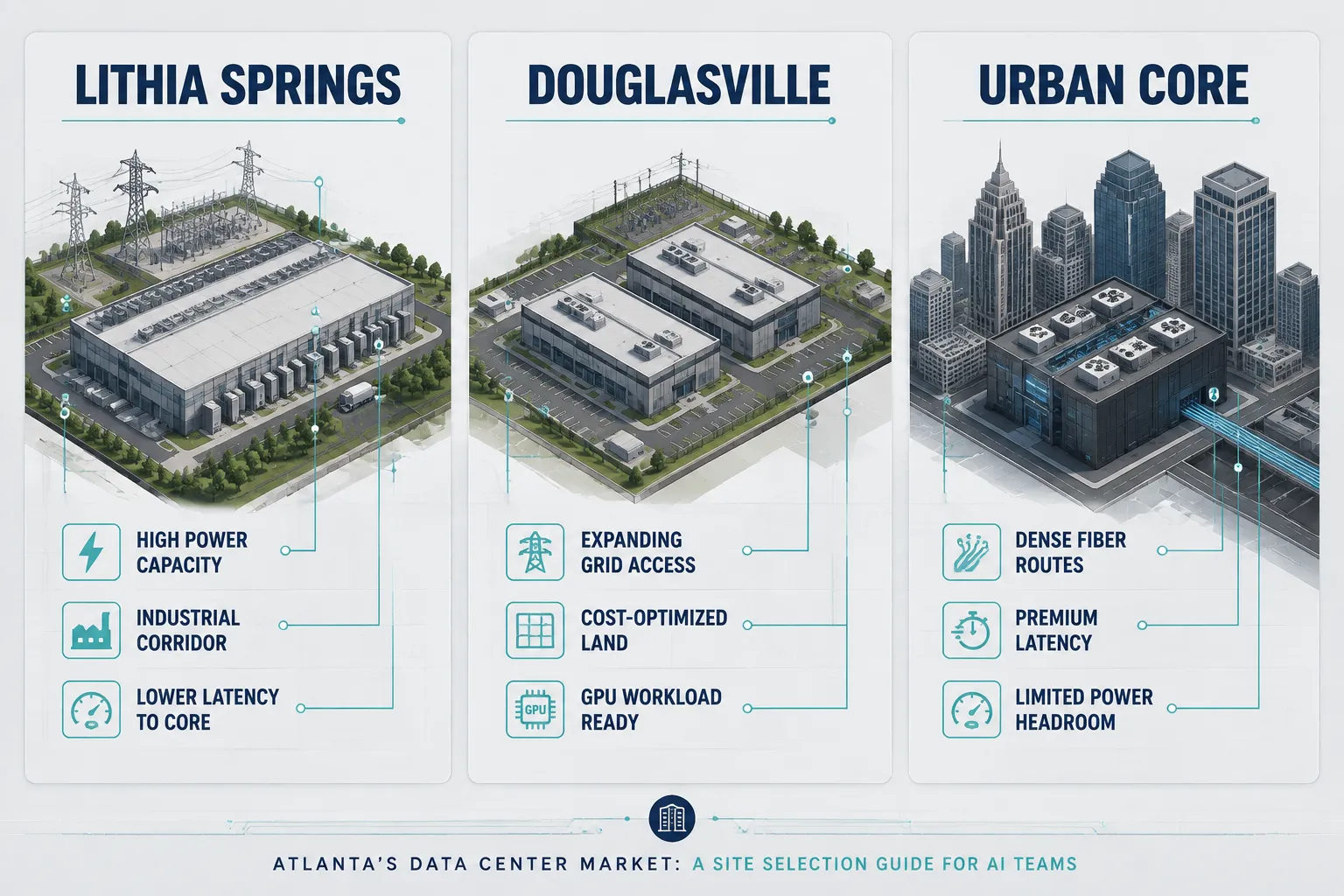
- The market spans distinct submarkets, Lithia Springs, Douglasville, and the urban core, each with different power availability and latency profiles.
- AI teams should evaluate colocation, hyperscale leasing, and build-to-suit options against their specific compute density and timeline requirements.
- Georgia’s data center tax exemption program significantly reduces total cost of ownership for qualifying tenants.
- Site selection decisions should account for power redundancy, cooling efficiency (PUE), fiber diversity, and long-term capacity expansion options.
Why Atlanta Has Become a Tier-1 AI Infrastructure Hub
Atlanta’s rise as a data center destination is not accidental. The city sits at the intersection of several structural advantages that align closely with what AI workloads demand.
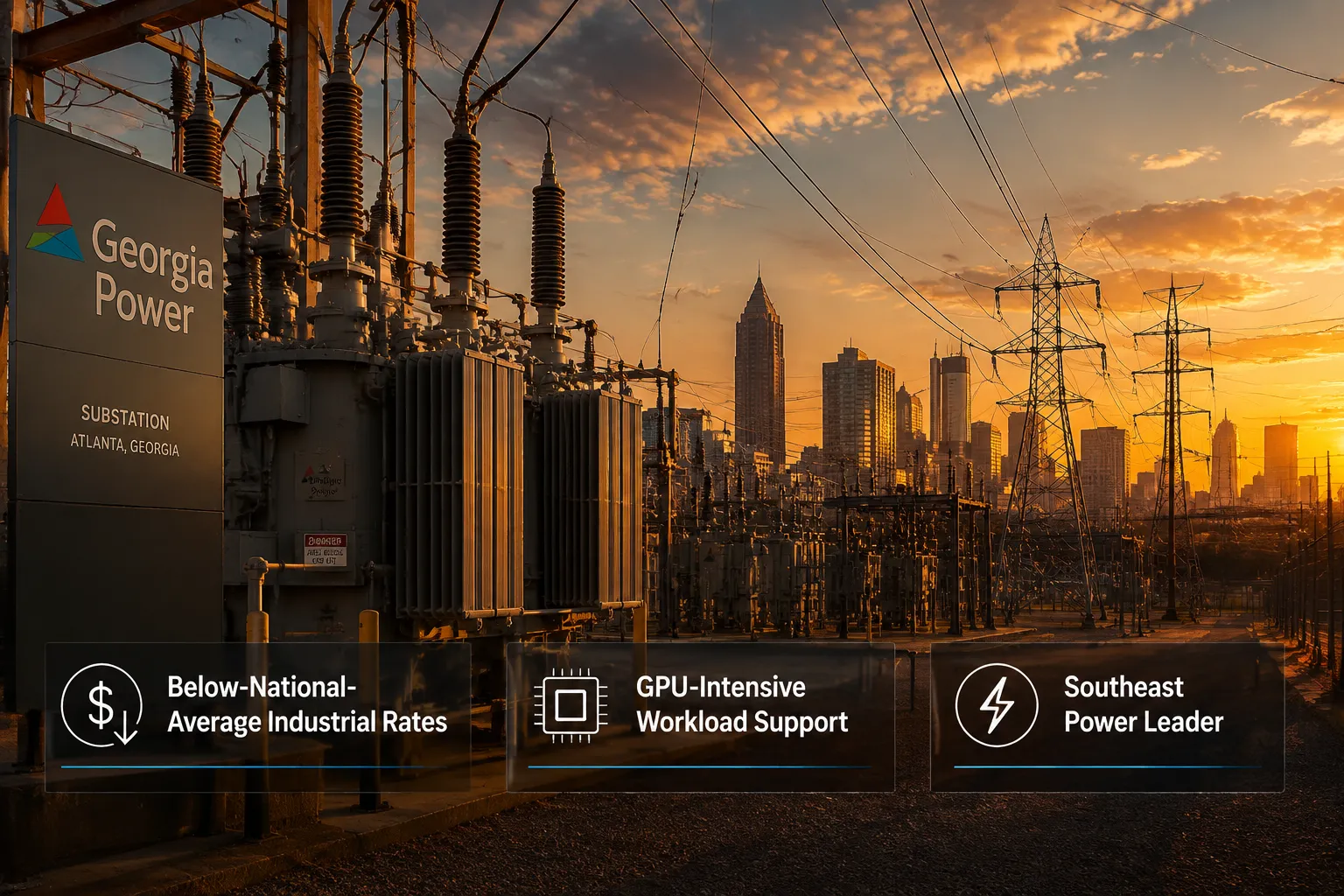
Power cost and availability stand out first. Georgia Power’s industrial rates consistently fall below the national average, and the state’s diverse generation mix, including nuclear, natural gas, and growing renewables, provides both price stability and reliability. For AI training clusters that can consume tens of megawatts continuously, this matters enormously.
Fiber density is the second pillar. Atlanta is home to one of the largest internet exchange points in the Southeast, the Atlanta Internet Exchange (ATL-IX). Multiple Tier 1 carriers, including AT&T, Lumen, and Zayo, maintain significant infrastructure in the metro area. This translates to low-latency connectivity to financial centers in New York, tech hubs on the West Coast, and international gateways in Miami.
Tax incentives add another layer of appeal. Georgia’s sales and use tax exemption for data center equipment, applicable to servers, cooling systems, and power infrastructure, can represent 7-8% savings on capital expenditures for qualifying projects. Combined with local property tax abatements available in several counties, the total incentive package is competitive with established markets like Northern Virginia and Dallas.
“Atlanta’s combination of affordable power, fiber richness, and state-level incentives creates a rare convergence that AI infrastructure teams should not overlook.”, Infrastructure analyst consensus, 2026
The talent ecosystem rounds out the picture. Georgia Tech, Emory University, and a growing cluster of AI startups have seeded a technical workforce familiar with GPU infrastructure, distributed systems, and MLOps practices. For teams that plan to operate their own facilities, local talent availability reduces operational risk.
Key Atlanta Submarkets at a Glance
| Submarket | Primary Advantage | Typical Power Availability | Best Fit |
|---|---|---|---|
| Lithia Springs / Douglasville | Large campus sites, low cost | 20-100+ MW | Hyperscale AI training |
| Norcross / Suwanee | Established colo density | 1-20 MW | Enterprise AI inference |
| Downtown / Midtown | Latency-sensitive apps | Under 5 MW | Edge AI, financial AI |
| College Park | Airport proximity, logistics | 5-30 MW | Hybrid cloud deployments |
A Practical Site Selection Framework for Atlanta’s Data Center Market
Understanding why Atlanta works is only half the task. Atlanta’s Data Center Market: A Site Selection Guide for AI Teams must also address how AI teams should evaluate specific sites. The following framework breaks the process into four prioritized criteria.
1. Power Density and Scalability
AI workloads, particularly large language model training and inference, require power densities that traditional enterprise data centers were not designed to support. Standard colocation racks deliver 5-10 kW per rack. Modern GPU clusters routinely demand 30-80 kW per rack, with liquid-cooled configurations pushing beyond 100 kW.
When evaluating Atlanta facilities, AI teams should ask:
- What is the maximum critical load per cabinet?
- Is liquid cooling (direct-to-chip or rear-door heat exchangers) available or planned?
- What is the facility’s Power Usage Effectiveness (PUE) rating? Best-in-class Atlanta facilities now operate below 1.3 PUE.
- What is the expansion timeline if power requirements double within 18 months?
2. Network Architecture and Redundancy
Latency and bandwidth directly affect AI pipeline performance, particularly for distributed training jobs and real-time inference APIs. Evaluate:
- Carrier diversity: Minimum two diverse fiber entry points from separate carriers.
- On-net cloud connectivity: Direct connections to AWS, Azure, and Google Cloud via dedicated cross-connects reduce latency and egress costs.
- Peering options: Proximity to ATL-IX enables cost-effective peering arrangements for high-volume AI API traffic.
3. Cooling Infrastructure
Thermal management is the silent constraint in AI deployments. Traditional air cooling becomes inefficient above 20 kW per rack. Atlanta’s climate, hot, humid summers, places additional stress on air-side economization strategies.
Facilities that have invested in chilled water systems, immersion cooling readiness, or rear-door heat exchangers are better positioned to support next-generation GPU hardware. Request cooling capacity documentation and ask specifically whether the facility has deployed or is certified for direct liquid cooling.
4. Lease Structure and Contractual Flexibility
AI compute requirements are notoriously difficult to forecast. A team running a 10 MW cluster today may need 40 MW within two years, or may pivot to a cloud-first model entirely. Lease structures that lock teams into rigid multi-year commitments without expansion rights or exit provisions carry significant risk.
Key contractual terms to negotiate in Atlanta’s market:
- Expansion options: Right of first refusal on adjacent capacity.
- Power commitment clauses: Avoid penalties for underutilization during ramp-up phases.
- SLA specifics: Uptime guarantees of 99.999% (five nines) are the standard for AI production environments.
- Exit provisions: Termination rights tied to major power or cooling failures.
Georgia’s Incentive Programs: What AI Teams Qualify For
Georgia’s data center incentive framework is structured around investment and job creation thresholds. As of 2026, the primary programs include:
- Sales tax exemption on data center equipment for facilities investing a minimum of $15 million and creating at least 20 jobs.
- County-level property tax abatements in Paulding, Douglas, and Coweta counties, often structured as 10-year phased reductions.
- OneGeorgia Authority grants for facilities locating in designated rural opportunity zones adjacent to the Atlanta metro.
AI teams should engage Georgia’s Department of Economic Development early in the site selection process. Incentive negotiations are most effective before a Letter of Intent is signed.
FAQ: Atlanta Data Center Site Selection for AI Teams
What is the minimum power commitment typical for Atlanta colocation providers? Most Atlanta colocation providers offer contracts starting at 100 kW, with hyperscale wholesale leases beginning at 1 MW. AI teams with GPU clusters typically start negotiations at 500 kW to 2 MW.
How does Atlanta compare to Northern Virginia for AI workloads? Northern Virginia offers greater existing hyperscale density, but faces severe power constraints and higher costs. Atlanta provides more available land, lower power rates, and faster permitting timelines, making it preferable for teams with flexibility on geographic location.
Are there Atlanta facilities specifically designed for GPU-dense deployments? Yes. Several operators, including QTS, CyrusOne, and Switch, have announced or delivered high-density AI-ready pods in the Atlanta metro with liquid cooling infrastructure and power densities above 30 kW per rack.
What fiber providers have the strongest presence in Atlanta’s data center submarkets? Zayo, Lumen, AT&T, Crown Castle Fiber, and Comcast Business all maintain dense infrastructure in the Lithia Springs and Norcross submarkets. Most Tier 1 Atlanta facilities offer at least three diverse carrier options.
How long does permitting typically take for a new data center build in the Atlanta suburbs? Permitting timelines in Douglas and Paulding counties typically run 6-12 months for greenfield builds, compared to 18-24 months in more congested markets. Pre-permitted sites can reduce this to under 90 days.
Is renewable energy available for AI teams with sustainability mandates? Georgia Power offers renewable energy tariffs under its Green Energy Program, and several Atlanta-area facilities have signed Power Purchase Agreements (PPAs) for solar generation. 100% renewable matching is achievable but requires advance planning.
Conclusion
Atlanta’s Data Center Market: A Site Selection Guide for AI Teams is more than a regional overview, it is a decision framework for teams that cannot afford to get infrastructure wrong. The market’s combination of affordable power, dense fiber, favorable tax policy, and rapidly expanding high-density capacity makes it one of the strongest contenders for AI infrastructure investment in 2026.
Actionable next steps for AI teams:
- Define your 24-month power and compute density requirements before engaging any provider.
- Issue a formal RFP to at least three Atlanta-area operators across different submarkets to benchmark pricing and availability.
- Engage Georgia’s Department of Economic Development to assess incentive eligibility before signing any lease.
- Commission an independent technical audit of shortlisted facilities, focusing on cooling infrastructure and power redundancy.
- Retain a data center broker with Atlanta-specific experience to navigate lease negotiations and expansion rights.
The window to secure favorable terms in Atlanta’s market is narrowing as demand from AI teams accelerates. Moving with a structured, criteria-driven approach is the difference between locking in a strategic infrastructure advantage and joining a waiting list.
References
- Jones Lang LaSalle (JLL). (2024). North America Data Center Outlook. JLL Research.
- CBRE. (2024). H2 2024 North America Data Center Trends. CBRE Research.
- Georgia Department of Economic Development. (2023). Data Center Tax Exemption Program Overview. Georgia.org.
- Cushman & Wakefield. (2024). Global Data Center Market Comparison Report. Cushman & Wakefield Research.
- Uptime Institute. (2023). Global Data Center Survey: Power and Cooling Trends. Uptime Institute.
- Structure Research. (2024). Atlanta Metro Data Center Market Analysis. Structure Research.
Meta Title: Atlanta Data Center Market: AI Team Site Selection Guide
Meta Description: Explore Atlanta’s data center market in 2026. This site selection guide helps AI teams evaluate power, cooling, fiber, incentives, and lease structures for GPU-dense workloads.
Tags: Atlanta data center market, AI infrastructure, site selection, data center colocation, GPU workloads, Georgia data center incentives, hyperscale leasing, power density, liquid cooling, fiber connectivity, AI teams, data center real estate
Contributing writer at CoreGrid AI Infrastructure.