
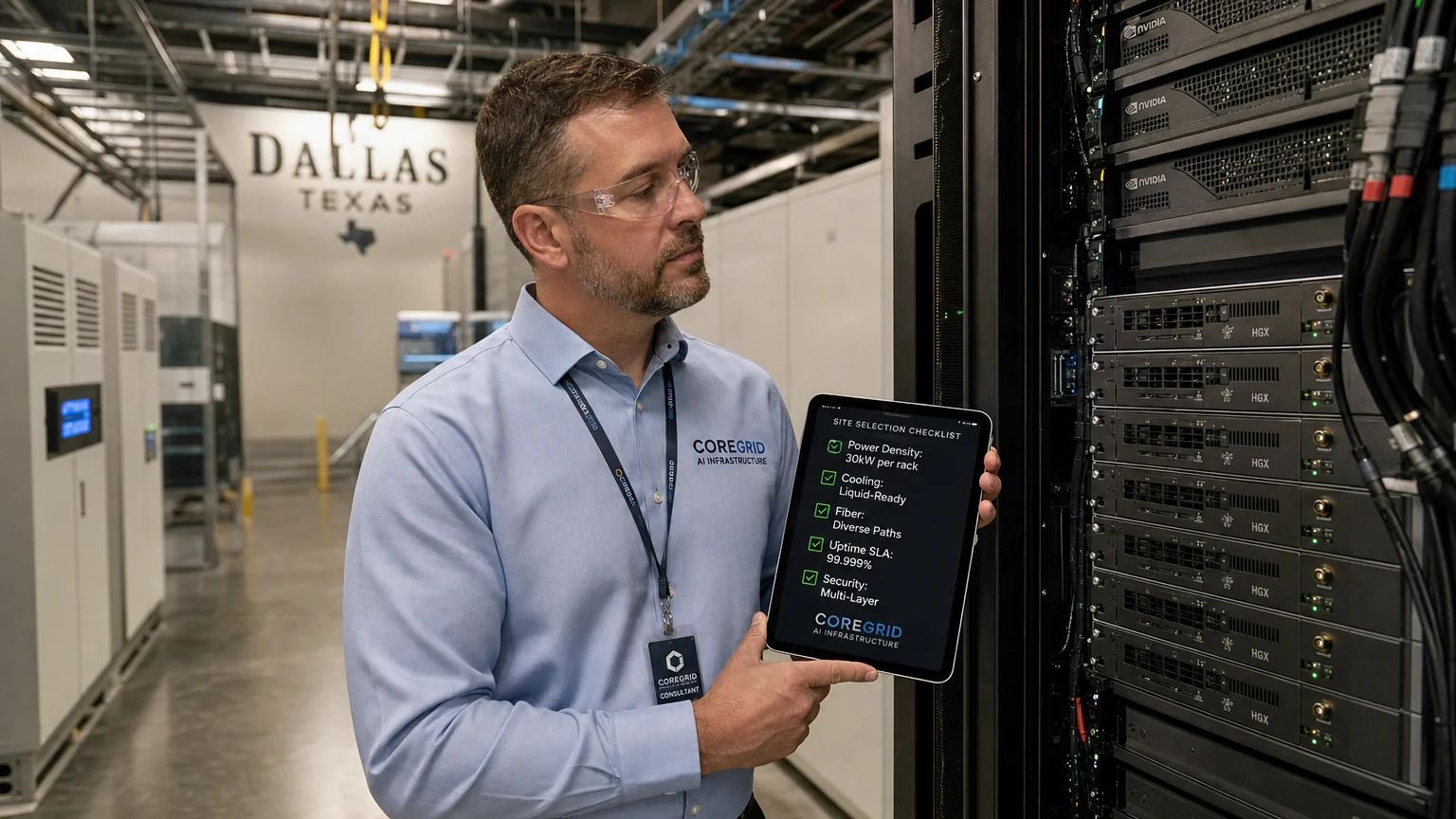
Liquid-Cooling Readiness Assessments for AI and GPU Infrastructure
CoreGrid AI Infrastructure helps companies planning AI, GPU, or high-performance computing deployments understand whether their target facility or colocation environment can actually support liquid cooling — before they sign contracts or purchase hardware.
This service is designed for AI startups, SaaS companies, enterprise IT teams, and cloud operators who are moving into high-density compute and need an honest, vendor-neutral read on their cooling options. CoreGrid is a consulting and planning firm — not a data center owner, cooling vendor, or equipment manufacturer.
What Is a Liquid-Cooling Readiness Assessment?
A liquid-cooling readiness assessment is a structured analysis of whether a facility, colocation environment, or planned infrastructure deployment can support liquid-based cooling for high-density AI and GPU workloads. It covers workload density requirements, mechanical and power constraints, cooling architecture options, and market availability — and it stops short of licensed engineering, construction, or utility work.
This service is relevant any time planned rack densities exceed what conventional air cooling can reliably handle. Modern GPU servers — particularly those running large language model training or inference at scale — routinely push 30–100+ kW per rack, well beyond the 8–15 kW range that most legacy air-cooled data center rows were designed for.
CoreGrid’s assessment is advisory and planning-focused. It gives your team the information needed to have informed conversations with colocation providers, mechanical engineers, and hardware vendors — without being steered by any one of them.
What’s the difference between direct liquid cooling and immersion cooling?
Direct liquid cooling (DLC) routes coolant through cold plates attached directly to CPUs, GPUs, and other heat-generating components, while immersion cooling submerges entire servers in a dielectric fluid bath. DLC is more widely available in current colocation environments and is compatible with many standard server form factors. Immersion cooling offers higher thermal efficiency but requires specialized tanks, fluids, and facility modifications that limit where it can be deployed today.
At what rack density does liquid cooling become necessary?
There is no universal threshold, but most data center operators and hardware vendors treat 30 kW per rack as the practical upper limit for reliable air cooling in a standard colocation environment. Many modern AI GPU servers — including dense H100 and similar configurations — can exceed this at full utilization. Above 40–50 kW per rack, liquid cooling is generally required, not optional.
Does a readiness assessment replace a mechanical engineering study?
No. A readiness assessment is a planning and advisory analysis — it identifies gaps, evaluates options, and produces actionable guidance. A licensed mechanical engineering study involves stamped drawings, utility coordination, and construction-level specifications. CoreGrid does not provide licensed engineering services; the assessment is designed to inform those conversations, not replace them.
Signs You Need a Liquid-Cooling Readiness Assessment
A liquid-cooling readiness assessment is most valuable when at least one of the following conditions applies to your deployment:
- You are planning a GPU cluster with rack densities above 20 kW. Standard air-cooled colocation rows may not support your workload without facility modifications or a liquid-cooling-ready provider.
- You are evaluating colocation contracts and unsure which facilities support high-density cooling. Not all data centers advertise liquid-cooling availability clearly — and availability varies significantly by market.
- Your hardware vendor has specified liquid cooling as required or recommended. Many current-generation AI accelerators ship with liquid-cooling guidance baked into their thermal specifications.
- You are expanding an existing AI deployment and hitting thermal limits. If current racks are running hot or facilities are flagging thermal density issues, a readiness review can clarify your options before you add capacity.
- You are evaluating multiple U.S. markets for a new AI deployment. Liquid-cooling availability differs across Dallas, Northern Virginia, Phoenix, and other markets — a readiness assessment can incorporate that market context. See our blog for market-by-market analysis.
- You are an investor or operator conducting technical due diligence on an AI infrastructure project. Understanding cooling readiness is a material factor in project feasibility and cost modeling.
- Your team lacks in-house expertise on cooling architecture trade-offs. If no one on your team has evaluated DLC vs. immersion vs. rear-door heat exchanger options before, an external assessment reduces the risk of a costly mismatch.
How Much Does a Liquid-Cooling Readiness Assessment Cost in Dallas, TX?
Pricing for a liquid-cooling readiness assessment depends on the scope of the engagement, and CoreGrid has not published standard rates. Specific pricing requires a direct conversation about your project.
The table below outlines the factors that typically drive assessment scope and cost for this type of advisory engagement:
| Service / Situation | Typical Range | What Affects Price |
|---|---|---|
| Single-facility readiness review | Contact for quote | Number of facilities reviewed, depth of analysis required |
| Multi-site or multi-market assessment | Contact for quote | Number of markets, complexity of workload requirements |
| Assessment bundled with related planning services | Contact for quote | Scope of overall infrastructure engagement |
CoreGrid does not publish fixed-rate pricing. Contact us for a scoped estimate based on your specific deployment.
What’s typically included in an assessment engagement:
- Discovery call to define workload density requirements and project context
- Review of facility data, power envelope, and mechanical constraints
- Cooling architecture comparison relevant to your deployment scenario
- Structured findings briefing with readiness gaps and recommended next steps
- Vendor-neutral guidance — no referral fees, no provider bias
What may not be included:
- Licensed mechanical or electrical engineering services
- Utility interconnection or power contract negotiation
- Construction-level drawings or stamped specifications
- On-site physical inspection (scope-dependent — confirm at engagement)
- Hardware procurement or vendor contracting
How long does a liquid-cooling readiness assessment take?
Engagement timelines vary with scope, but a focused single-facility assessment can typically be completed in a matter of weeks from the initial discovery call. Multi-site or multi-market assessments take longer. CoreGrid can provide a timeline estimate once your project scope is defined.
Is a liquid-cooling readiness assessment a one-time engagement or ongoing?
Most clients engage CoreGrid for a defined assessment project with a clear deliverable. Some clients return for updated assessments as their infrastructure plans evolve or as new GPU hardware generations change their density requirements. There is no mandatory ongoing retainer.
Can the assessment be done remotely, or does it require a site visit?
CoreGrid can conduct a significant portion of the assessment using facility documentation, provider specifications, and market data. Whether an on-site component is warranted depends on your specific project — discuss this during the initial discovery call.
Why Choose CoreGrid AI Infrastructure?
CoreGrid AI Infrastructure is a Dallas-based consulting and planning firm with 6 years of experience supporting AI, GPU, cloud, and high-performance computing infrastructure decisions. The firm has reviewed more than 120 data center and colocation projects across 18 U.S. markets and has supported more than $420 million in infrastructure planning decisions.
Key reasons clients engage CoreGrid for liquid-cooling readiness work:
- Vendor-neutral positioning. CoreGrid does not own data centers, sell cooling equipment, or receive referral fees from providers. Recommendations reflect your requirements, not vendor relationships.
- AI and GPU workload focus. The firm’s practice is built around the specific density, power, and cooling challenges of modern AI infrastructure — not general IT consulting.
- Multi-market perspective. With experience across Dallas-Fort Worth, Northern Virginia, Phoenix, Chicago, Atlanta, and other major U.S. markets, CoreGrid can contextualize cooling availability across the markets most relevant to your deployment.
- Planning-stage value. Assessments are designed to inform decisions before contracts are signed — when course corrections are least expensive.
- Experienced advisory team. Learn more about the team’s background on the about CoreGrid AI Infrastructure page.
CoreGrid does not claim to be the only firm offering this service, and does not make guarantees about facility availability, power contracts, or cooling capacity at any specific provider.
Book Your Liquid-Cooling Readiness Assessment in Dallas, TX
CoreGrid AI Infrastructure has supported more than 120 data center and colocation projects across 18 U.S. markets, with more than $420 million in infrastructure decisions informed by vendor-neutral analysis. If you are planning an AI or GPU deployment and need an honest read on whether your target facility can support liquid cooling, this is the right starting point.
Here’s what happens after you reach out:
- A member of the CoreGrid team contacts you — typically within one business day.
- You have a brief discovery call to describe your workload, timeline, and facility context.
- CoreGrid scopes the assessment and provides a clear outline of what the engagement covers.
- Work begins on a timeline agreed to by both parties.
Call: (214) 555-0196 Email: hello@coregridai.com Online: Contact CoreGrid AI Infrastructure
There is no obligation to proceed beyond the initial conversation. CoreGrid’s goal is to give you the information you need to make a confident infrastructure decision — not to lock you into a long engagement before you know what you’re getting.
Explore the full range of our services or get a free quote for your specific project.
Last updated: July 2026
Areas We Serve
Frequently Asked Questions
What does a liquid-cooling readiness assessment from CoreGrid actually cover?
CoreGrid's assessment covers workload density requirements, facility mechanical constraints, cooling architecture options, and colocation market availability. The output is a structured planning brief your team can use to guide vendor conversations and infrastructure decisions. It does not include licensed mechanical engineering, utility interconnection, or construction services.
Does CoreGrid own or operate data centers with liquid cooling?
No. CoreGrid AI Infrastructure is a consulting and planning firm, not a data center owner or operator. The assessment helps you evaluate readiness and identify the right facility partners — it does not commit you to any specific provider or facility.
Is a liquid-cooling readiness assessment only relevant for large enterprises?
No. AI startups, SaaS companies, and mid-market GPU teams frequently need this assessment before committing to colocation contracts or hardware purchases. High-density GPU workloads can exceed air-cooling limits at relatively small rack counts, making this relevant at almost any scale of AI deployment.
How is CoreGrid's assessment different from a colocation provider's free site review?
A colocation provider's review is designed to sell you their facility. CoreGrid's assessment is vendor-neutral — the goal is to clarify your requirements and help you ask better questions of any provider, not to steer you toward a specific one. That independence is particularly valuable when you are comparing multiple facilities or markets.
Can CoreGrid assess readiness for facilities outside Dallas?
Yes. CoreGrid supports clients across major U.S. data center markets including Austin, Houston, Phoenix, Atlanta, Northern Virginia, Chicago, Columbus, Las Vegas, Salt Lake City, Denver, New York Metro, Los Angeles, San Jose, Seattle, and Miami. The assessment framework applies regardless of geography, and market-specific cooling availability data is incorporated where relevant.
What triggers the need for a liquid-cooling readiness assessment?
The most common triggers are planning a GPU cluster deployment, evaluating colocation options for high-density AI racks, or discovering that a target facility's cooling capacity may not support planned workloads. It is most valuable before signing a colocation contract or purchasing high-density servers — when the cost of a wrong decision is highest.
Does CoreGrid provide a written deliverable at the end of the assessment?
CoreGrid provides a structured findings briefing covering readiness gaps, risk factors, and recommended next steps. For specifics on deliverable format, depth, and scope, [contact the team directly](/contact/) or call (214) 555-0196 to discuss your project.