
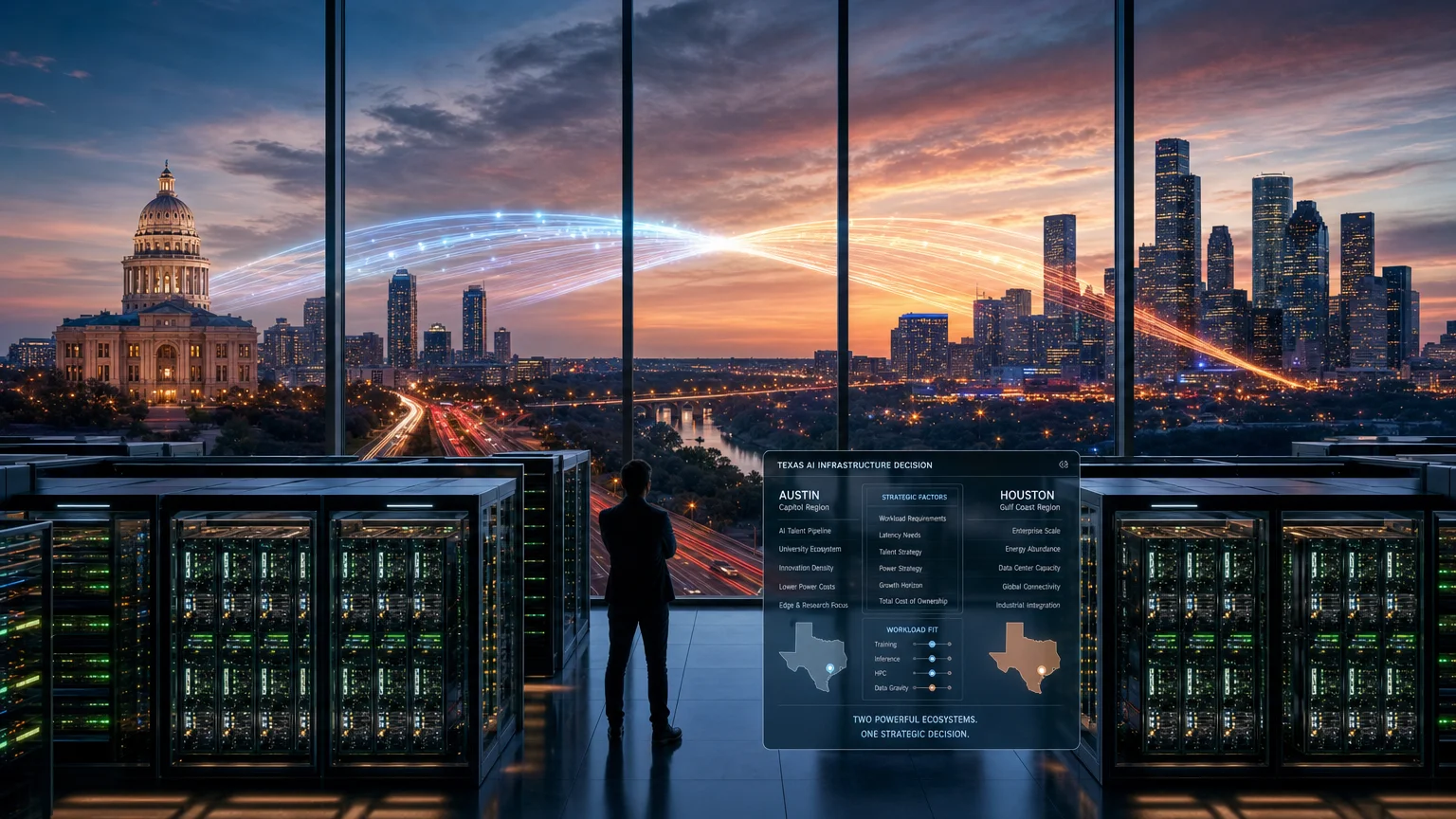
AI Data Center Site Selection: Vendor-Neutral Advisory for High-Density Compute Deployments
CoreGrid AI Infrastructure helps growing companies identify, compare, and select data center sites capable of supporting AI, GPU, and high-performance computing workloads. This service is designed for AI startups, enterprise IT teams, SaaS companies, and investors who need an objective, research-backed answer to a high-stakes question: where should we deploy, and why? CoreGrid operates as an independent consulting firm — not a data center owner, not a colocation broker — so every recommendation is built around your requirements. Learn about the full range of services CoreGrid offers.
What Is AI Data Center Site Selection?
AI data center site selection is the structured process of evaluating geographic markets, specific facilities, and infrastructure conditions to determine where AI and high-density compute workloads can be reliably and cost-effectively deployed. It goes well beyond picking a city — it involves analyzing power availability, cooling infrastructure, colocation capacity, network latency, redundancy options, and market-level risk before any lease or deployment commitment is made.
This service is distinct from general IT procurement or real estate consulting. It requires understanding the specific technical demands of AI and GPU workloads — including high rack density, liquid-cooling compatibility, and power draw per cabinet — and matching those demands against what individual markets and facilities can actually deliver today and at projected scale.
CoreGrid does not provide electrical engineering, utility interconnection, construction, legal, or licensed engineering services. The scope is advisory, analytical, and strategic: helping clients understand their options and make informed decisions before committing capital.
What factors matter most in AI data center site selection?
Power availability is consistently the most constrained variable in AI data center site selection. High-density GPU clusters can require 30–100+ kW per rack, and not every market — or every facility within a market — has the available utility capacity to support that at scale. Beyond power, key factors include cooling infrastructure readiness (particularly for liquid cooling), network latency to end users or cloud on-ramps, colocation market pricing, and the facility’s ability to scale with your workload over time.
How is AI data center site selection different from standard data center site selection?
Standard data center site selection was historically optimized for enterprise IT workloads running at 5–10 kW per rack. AI and GPU infrastructure routinely demands 30–100+ kW per rack, requires direct liquid cooling or immersion cooling compatibility, and generates significantly more heat per square foot. These differences mean that a facility that works well for traditional enterprise workloads may be technically unsuitable for AI deployment — making AI-specific site evaluation a distinct discipline.
Who typically needs AI data center site selection consulting?
Companies that benefit most are those planning their first large-scale AI or GPU deployment, expanding from a single market to multiple regions, or evaluating whether their current colocation arrangement can support growing compute demands. This includes AI-native startups scaling inference infrastructure, enterprise IT teams building out private AI environments, and investors conducting technical due diligence on data center capacity commitments. Read more about AI infrastructure planning on our blog.
Signs You Need AI Data Center Site Selection
A structured site selection engagement is the right move when observable conditions suggest your current approach carries meaningful risk or leaves significant cost and performance on the table.
- You’re planning a GPU or AI cluster deployment and haven’t evaluated power capacity at the facility level. Power constraints are the leading cause of delayed or failed AI infrastructure deployments — and they’re not always visible until you’re deep into a colocation negotiation.
- You’re comparing multiple markets but don’t have a consistent framework for evaluating them. Without a structured comparison methodology, market decisions often default to familiarity or vendor relationships rather than technical fit.
- Your current colocation provider can’t confirm available capacity for high-density racks. Many legacy facilities were not designed for 30+ kW per cabinet — and providers don’t always volunteer that limitation upfront.
- You’re evaluating a multi-city infrastructure strategy and need to sequence deployments by market readiness. Not all markets have equal capacity, pricing, or timeline to deployment — sequencing matters.
- You’re an investor or executive conducting due diligence on a data center-dependent business. Site selection research provides an independent read on whether infrastructure commitments are technically sound.
- You’ve received conflicting guidance from colocation sales teams. Vendor-neutral analysis cuts through commercially motivated recommendations and gives you a clear, unbiased picture.
- Your workload requirements have grown significantly since your last infrastructure review. What worked at 500 kW may not scale to 5 MW — and the right facility or market may have changed.
How Much Does AI Data Center Site Selection Cost in Dallas, TX?
Pricing for AI data center site selection consulting is not fixed — it depends on the scope of the engagement, the number of markets being evaluated, and the complexity of your workload requirements. CoreGrid does not publish standard rates because a single-market evaluation for an early-stage startup involves meaningfully different work than a multi-city strategy engagement for an enterprise client. Contact CoreGrid to discuss your specific situation and receive a scoped proposal.
The table below outlines the variables that typically shape engagement scope and cost.
| Service Situation | Typical Scope Drivers | What Affects Price |
|---|---|---|
| Single-market site evaluation | One target city, 2–4 facility candidates | Number of sites analyzed, depth of power research |
| Multi-market comparison | 3–6 U.S. markets evaluated in parallel | Number of markets, colocation capacity research depth |
| Enterprise or investor due diligence | Technical review of existing commitments | Data complexity, timeline urgency, deliverable format |
| Early-stage startup advisory | Requirements scoping + initial market shortlist | Clarity of requirements, number of revision cycles |
What’s included in a CoreGrid site selection engagement:
- Power availability and capacity research for candidate markets and facilities
- Market-by-market comparison against your technical and operational criteria
- Vendor-neutral scoring and shortlist of recommended sites
- Structured advisory report with findings, trade-offs, and recommended next steps
- Follow-up availability to support your internal decision process
What may not be included:
- Electrical engineering or utility interconnection analysis (licensed engineering services)
- Legal review of colocation contracts or lease terms
- Construction or buildout planning
- Guaranteed power or capacity commitments (those are made directly with facility providers)
- Services outside the scope agreed at engagement start
How long does AI data center site selection take?
Engagement length depends on the number of markets, the complexity of your requirements, and your decision timeline. CoreGrid scopes the expected timeline during the initial discovery call so you have a clear expectation before work begins. Straightforward single-market evaluations typically move faster than multi-city strategy engagements.
Does site selection cost vary by market?
Yes. Some markets require more research depth than others — particularly markets where power availability data is less transparent or where colocation capacity is constrained and changing rapidly. CoreGrid accounts for market-specific research complexity when scoping an engagement.
Is a site selection engagement a one-time project or an ongoing retainer?
Most engagements are scoped as discrete projects with a defined deliverable — typically a research report and recommendation. Clients with ongoing expansion plans or multi-phase deployments sometimes return for follow-on engagements as their requirements evolve. CoreGrid can discuss both project and retainer structures depending on your needs.
Why Choose CoreGrid AI Infrastructure?
CoreGrid AI Infrastructure is a Dallas-based consulting and planning firm with 6 years of experience supporting AI, GPU, cloud, and high-performance computing infrastructure decisions.
- 6+ years focused on data center and infrastructure planning for compute-intensive workloads
- 120+ data center and colocation projects reviewed across the U.S.
- 18 U.S. data center markets analyzed, including Dallas-Fort Worth, Phoenix, Northern Virginia, Atlanta, Chicago, and beyond
- $420M+ in infrastructure decisions supported across AI, GPU, cloud, SaaS, enterprise IT, and private-cloud clients
- Vendor-neutral by design — CoreGrid has no financial relationship with any colocation provider, data center operator, or chip manufacturer; recommendations reflect your requirements
- Market-by-market power and capacity research conducted as part of every site selection engagement
- AI, inference, and high-density workload planning is the core of the practice — not a peripheral add-on to a general IT consulting business
Learn more about CoreGrid’s background and approach. CoreGrid’s practice spans AI data center site selection, GPU colocation sourcing, high-density rack planning, AI server deployment planning, and liquid-cooling readiness assessments — the full set of services needed to plan a credible AI infrastructure deployment.
Book Your AI Data Center Site Selection Engagement in Dallas, TX
CoreGrid AI Infrastructure has reviewed 120+ data center and colocation projects across 18 U.S. markets and supported more than $420M in infrastructure decisions — all as a vendor-neutral advisory firm with no financial ties to any facility provider. If you’re planning an AI or GPU deployment and need a clear, research-backed answer on where and how to deploy, this is the right starting point.
Here’s what happens after you reach out:
- A CoreGrid advisor reviews your inquiry and responds within one business day.
- You’re scheduled for a discovery call to discuss your compute requirements, target markets, and timeline.
- CoreGrid scopes the engagement and provides a proposal before any work begins.
Call us: (214) 555-0196 Email: hello@coregridai.com Online: Submit your project details via our contact form
There’s no obligation on the discovery call. If CoreGrid isn’t the right fit for your situation, we’ll tell you that directly.
Last updated: July 2026
Areas We Serve
Frequently Asked Questions
What does AI data center site selection actually involve?
AI data center site selection is the process of identifying, comparing, and recommending data center locations and facilities that can support AI, GPU, and high-density compute workloads. CoreGrid evaluates factors including power availability, cooling infrastructure, colocation market conditions, latency to end users, and redundancy options — then delivers a structured recommendation aligned to your specific requirements. The output is an advisory report, not a binding contract or a real estate transaction.
Does CoreGrid own or operate the data centers it recommends?
No. CoreGrid AI Infrastructure is a consulting and planning firm, not a data center owner or operator. The company provides independent, vendor-neutral advisory services to help clients evaluate and compare third-party colocation facilities and markets. This independence means recommendations are based on your requirements, not on any commercial relationship with a facility provider.
How long does an AI data center site selection engagement typically take?
Engagement length depends on the number of markets being evaluated, the complexity of your workload requirements, and how quickly decisions need to be made. CoreGrid scopes the expected timeline during the initial discovery call so you have a clear expectation before work begins. Clients with urgent timelines should mention that upfront so CoreGrid can assess feasibility.
Can CoreGrid support site selection outside of Dallas?
Yes. CoreGrid supports clients across major U.S. data center markets including Phoenix, Atlanta, Northern Virginia, Chicago, Columbus, Las Vegas, Salt Lake City, Denver, New York Metro, Los Angeles, San Jose, Seattle, and Miami — in addition to Dallas-Fort Worth, Austin, and Houston. The company is based in Dallas but the practice is national in scope.
What types of companies use AI data center site selection consulting?
CoreGrid works with AI startups, SaaS companies, cloud teams, enterprise IT departments, managed service providers, and investors evaluating data center expansion. Any organization planning to deploy AI, GPU, or high-density compute infrastructure — and needing an objective market and site evaluation before committing capital — can benefit from this service.
Does CoreGrid guarantee power availability or colocation capacity at selected sites?
No. CoreGrid provides research, analysis, and advisory recommendations based on available market data. The company cannot guarantee power availability, colocation capacity, or contract terms at any facility — those commitments are made directly between the client and the facility provider. CoreGrid's role is to give you the clearest possible picture of your options so you can negotiate from an informed position.
What information should I have ready before contacting CoreGrid?
It helps to have a general sense of your target compute capacity (number of racks or kilowatts needed), preferred geography or latency requirements, project timeline, and whether you are evaluating colocation, private cloud, or a hybrid approach. CoreGrid can work with early-stage or incomplete requirements and help you refine them during the discovery process — you don't need a finalized spec to start a conversation.