

Texas hosts two of the fastest-growing AI infrastructure markets in the United States — yet Austin and Houston serve meaningfully different types of compute teams. If your organization is evaluating GPU colocation in either city, the decision hinges on far more than geography. Power availability, market maturity, cooling constraints, and total cost of occupancy all vary significantly between the two metros, and choosing the wrong market can create real operational friction once your GPU cluster is live.
This guide walks through the key differences AI teams should weigh when comparing Austin vs Houston for GPU colocation, drawing on CoreGrid AI Infrastructure’s experience supporting clients across both Texas markets.
Key Takeaways
- Austin and Houston both operate on the ERCOT grid, but their power infrastructure maturity for high-density AI workloads differs considerably.
- Houston offers a larger, more established colocation market with deeper fiber density and more enterprise-grade carrier options.
- Austin’s market is growing rapidly, driven by the tech sector migration that accelerated through the early 2020s, but available high-density capacity remains tighter.
- Cooling is a shared challenge across both cities due to Texas heat, but Houston’s humidity adds complexity for air-cooled deployments.
- Total colocation cost per kilowatt tends to be lower in Houston for large-footprint GPU deployments, though Austin can be competitive for smaller, higher-density builds.
- AI startups and inference-focused teams often find Austin’s ecosystem alignment valuable; enterprise and energy-sector AI teams frequently gravitate toward Houston.
- Both markets sit within CoreGrid’s Texas service coverage, alongside AI data center site selection in Dallas and broader regional strategy work.
How Do Austin and Houston Compare on Power Infrastructure for GPU Workloads?
Both cities draw from the ERCOT grid, which means AI teams face the same statewide grid dynamics — including capacity constraints during peak summer demand. That said, the two markets are not equivalent when it comes to high-density power delivery at the facility level.
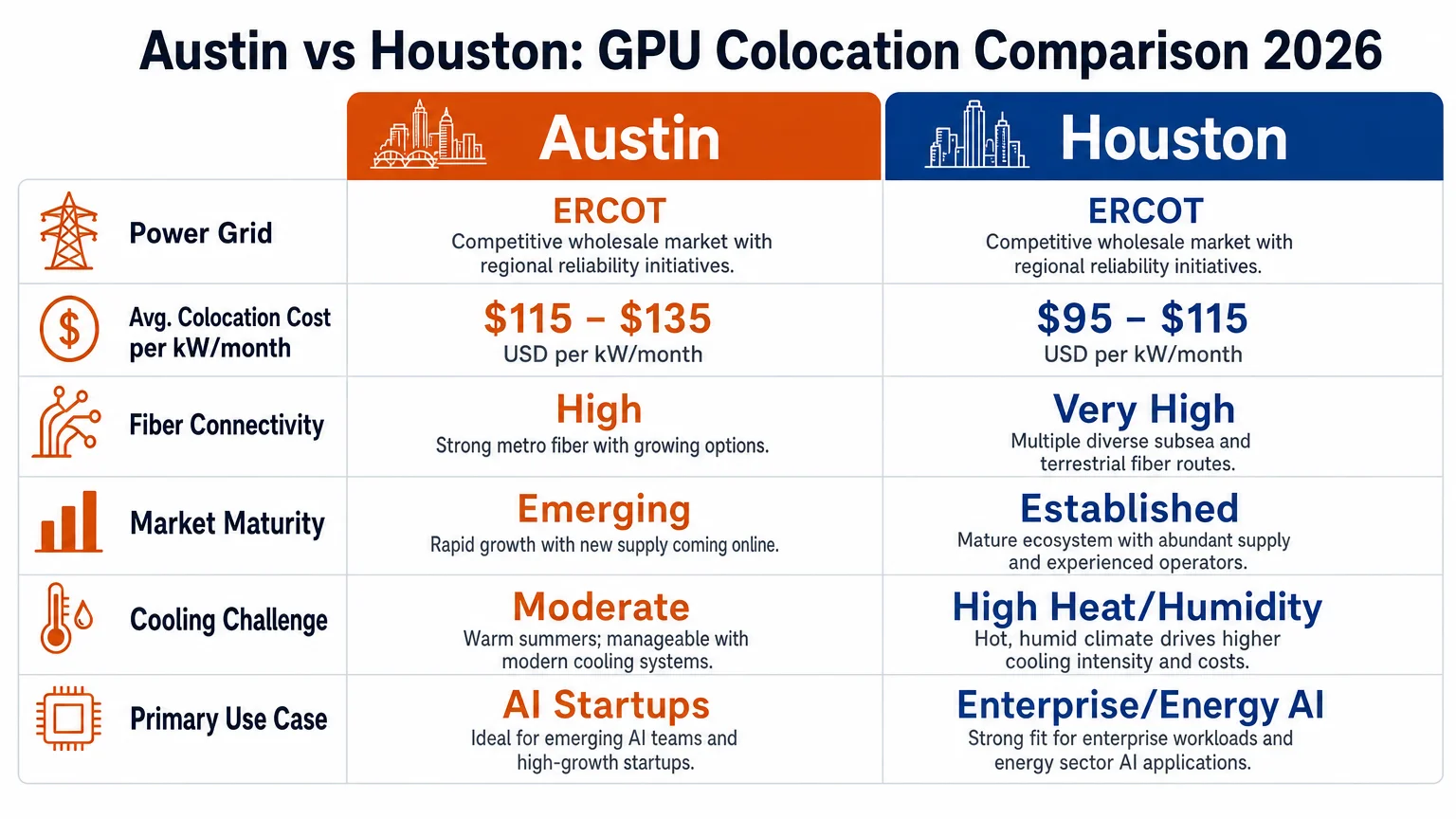
Houston’s data center market has been scaling high-density deployments longer, partly because the energy sector — oil, gas, and increasingly renewable energy companies — has driven demand for power-intensive compute infrastructure for years. Several Houston-area facilities have invested in substation upgrades and redundant power feeds capable of supporting 30kW to 50kW+ per rack, which is the range GPU clusters typically require. Austin facilities are catching up, but AI teams requesting 20MW+ of capacity in Austin should expect longer lead times and more limited provider options as of 2026.
For teams comparing power readiness across Texas markets more broadly, CoreGrid’s AI data center site selection work includes power availability research as a core deliverable — not just a checkbox.
What Does GPU Colocation Actually Cost in Austin vs Houston?
Pricing varies by provider, contract term, power density tier, and cooling approach, but some general patterns hold across the Texas market.
| Factor | Austin | Houston |
|---|---|---|
| Avg. colocation cost per kW/month | Higher (tighter supply) | Lower at scale |
| High-density rack availability | Limited, growing | More established |
| Fiber carrier diversity | Good | Very strong |
| Cooling infrastructure maturity | Moderate | High |
| Market competition among providers | Moderate | High |
| Typical contract flexibility | More flexible | More structured |
Houston’s larger market means more providers competing for enterprise GPU business, which generally produces more competitive pricing for teams deploying 500kW or more. Austin’s tighter supply of purpose-built AI-ready space means premium pricing is more common, particularly for deployments requiring liquid cooling or very high per-rack density.
That said, Austin can be cost-competitive for smaller AI inference deployments where a team needs 5–15 racks of GPU capacity and values proximity to Austin’s engineering talent base over raw cost-per-kW.
Austin vs Houston for GPU Colocation: How Does Cooling Factor In?
Cooling is one of the most consequential technical variables for GPU colocation in Texas, and it deserves direct attention when comparing these two markets.
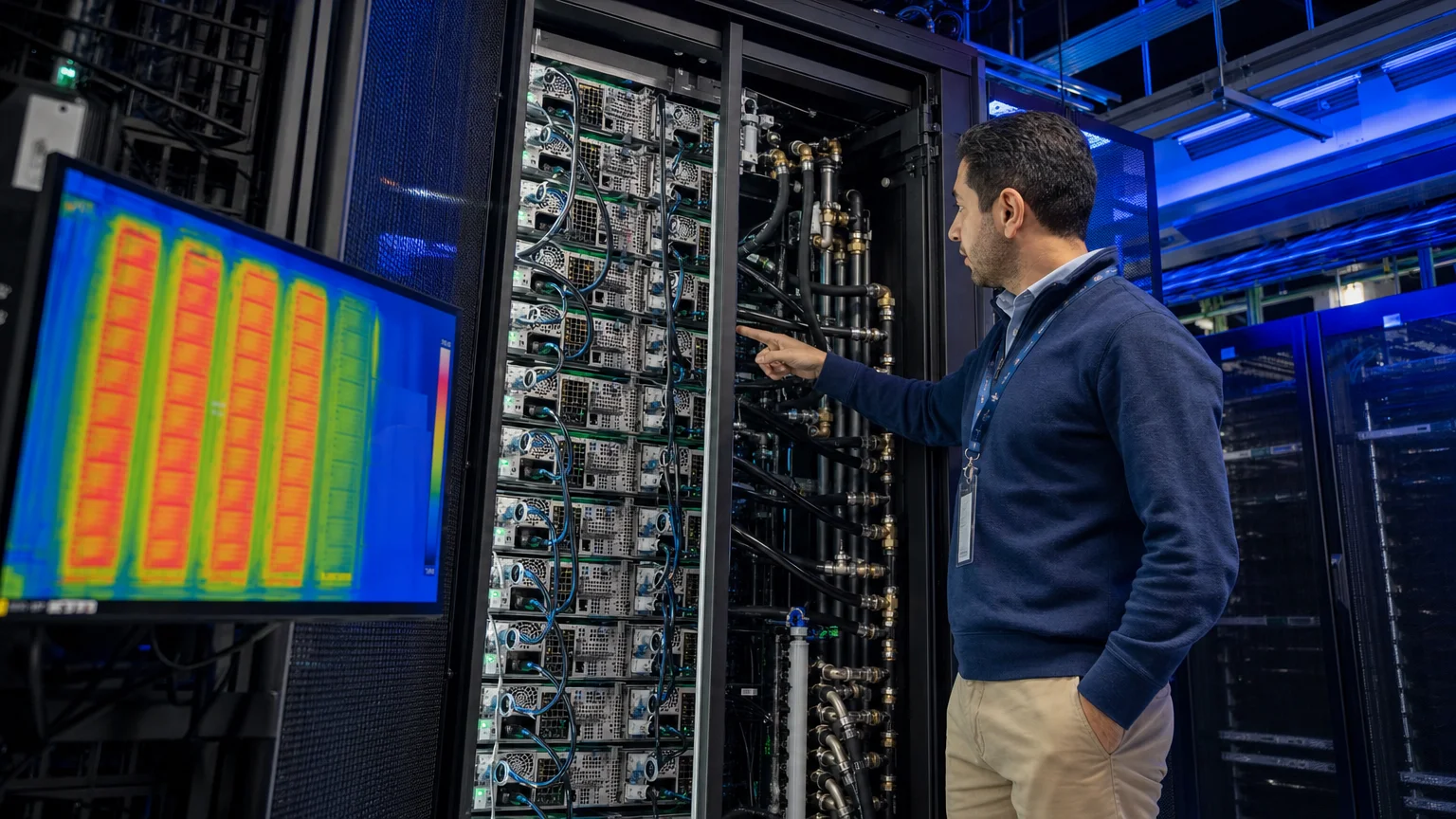
Air-cooled facilities in both cities face the same core problem: Texas summers routinely push ambient temperatures above 100°F, which compresses cooling headroom and increases PUE (Power Usage Effectiveness). For standard compute workloads, this is manageable. For GPU clusters running H100s or similar high-TDP hardware at full utilization, air cooling alone often cannot maintain the thermal envelope providers guarantee in their SLAs.
Houston adds a second variable — humidity. The Gulf Coast climate means Houston facilities must manage both heat and moisture, which increases the complexity and cost of air-side economization. Liquid cooling, whether direct-to-chip or rear-door heat exchangers, addresses both challenges more reliably. Teams planning dense GPU deployments in either city should conduct a liquid-cooling readiness assessment before committing to a facility, since not all Texas colocation providers have retrofitted their raised-floor environments for liquid delivery.
Austin’s drier climate gives it a modest advantage for air-side economization during shoulder seasons, but this benefit largely disappears during July and August when outdoor air is too hot to use for free cooling.
Which Market Is Better Suited for AI Startups vs Enterprise Teams?
The answer depends on what your team values most — ecosystem proximity, cost efficiency, or operational scale.
Austin tends to suit:
- AI startups and growth-stage companies that want proximity to Austin’s tech talent and VC ecosystem
- Inference-focused teams running smaller GPU footprints (under 500kW)
- Companies already headquartered in Austin that want to minimize latency to on-premise systems
- Teams that prioritize flexible contract terms over lowest cost-per-kW
Houston tends to suit:
- Enterprise AI teams with large, stable power requirements (1MW+)
- Energy sector companies deploying AI for seismic processing, reservoir modeling, or grid optimization
- Organizations that need carrier-neutral facilities with deep fiber diversity
- Teams running training workloads that require sustained high-density power over long contract terms
Neither market is universally superior. The right choice depends on your workload profile, team location, growth timeline, and budget structure. CoreGrid’s AI server deployment planning engagements typically include a market comparison phase specifically to resolve this question before a client signs a colocation agreement.
How Does Dallas Fit Into a Texas Multi-City GPU Strategy?
Many AI teams operating in Texas eventually consider a multi-city approach — using more than one market for redundancy, latency distribution, or capacity overflow. Dallas-Fort Worth is the most natural third node in a Texas GPU infrastructure strategy.
Dallas offers a more mature data center market than either Austin or Houston in terms of total available capacity, provider diversity, and established enterprise colocation infrastructure. For teams that need a primary high-density site with strong carrier access and a secondary or DR site in Austin or Houston, Dallas provides a well-tested anchor. CoreGrid’s Dallas vs Phoenix for AI Data Center Deployment 2026 analysis covers how Dallas stacks up against other major U.S. markets for teams thinking beyond Texas.
For teams considering Houston specifically as part of a deployment, CoreGrid also supports AI server deployment planning in Houston as a standalone engagement.
What Should AI Teams Verify Before Signing a Colocation Agreement in Either City?
Regardless of which Texas market a team selects, several due diligence steps apply universally to GPU colocation agreements.
- Power delivery confirmation: Verify that the facility can deliver your required kW per rack — not just total building power, but dedicated circuit capacity to your specific cage or suite.
- Cooling infrastructure audit: Confirm whether the facility supports liquid cooling, and if so, what delivery mechanism (CDU, rear-door, direct-to-chip) is available and at what cost.
- Fiber and carrier access: For AI teams with latency-sensitive inference workloads, confirm which carriers terminate in the facility and whether cross-connects are available.
- Expansion runway: GPU deployments often grow faster than planned. Confirm whether adjacent space or additional power capacity is available under the same agreement or at a known cost.
- SLA structure: Understand how the provider defines uptime, how they handle power interruptions, and what remedies exist if cooling thresholds are exceeded.
CoreGrid’s high-density rack planning work addresses many of these variables in advance, so clients enter provider negotiations with a clear technical specification rather than relying on the provider to define requirements.
Next Steps for AI Teams Evaluating Texas GPU Colocation
The Austin vs Houston GPU colocation decision is not one-size-fits-all. Power availability, cooling infrastructure, market pricing, and workload type all point toward different answers for different teams. What matters most is entering the evaluation with a clear technical specification — power density requirements, cooling preferences, latency constraints, and growth projections — before approaching providers.
CoreGrid AI Infrastructure supports AI teams through exactly this process: market comparison, facility shortlisting, technical requirement definition, and colocation sourcing across Dallas, Austin, Houston, and 15+ additional U.S. markets. To discuss your team’s GPU infrastructure requirements, book an infrastructure strategy call or visit the CoreGrid FAQ to learn more about how the firm works.
Frequently Asked Questions
Is Austin or Houston better for GPU colocation in 2026?
Houston generally offers more established high-density GPU colocation infrastructure, stronger carrier diversity, and more competitive pricing at scale. Austin is a better fit for smaller deployments, inference workloads, and teams that prioritize proximity to Austin's tech ecosystem over raw cost efficiency.
Do Austin and Houston data centers use the same power grid?
Yes. Both cities operate on the ERCOT grid. This means they share some of the same grid-level risk factors, but facility-level power infrastructure — substations, redundant feeds, UPS systems — varies significantly between individual providers in each market.
How much does GPU colocation cost per kW in Texas?
Pricing varies by provider, density tier, and contract term. Houston tends to offer lower per-kW rates for large deployments due to greater market competition. Austin pricing is often higher due to tighter supply of AI-ready space. A market comparison engagement can produce current pricing benchmarks before you negotiate.
Is liquid cooling available at Texas colocation facilities?
Some facilities in both Austin and Houston support liquid cooling, but availability is not universal. Teams planning high-TDP GPU deployments should confirm liquid cooling readiness with any facility before signing, rather than assuming it is available.
Can CoreGrid help compare specific providers in Austin and Houston?
Yes. CoreGrid AI Infrastructure provides vendor-neutral colocation comparison and [AI data center site selection in Austin](/ai-data-center-site-selection-in-austin) as part of its consulting services. The firm does not own data center space and has no financial relationship with specific providers, which supports objective comparison.
What is the typical lead time for GPU colocation space in Austin?
Lead times for purpose-built, high-density GPU space in Austin can run 3–9 months depending on power requirements and current facility capacity. Teams with near-term deployment timelines should begin the site selection process well in advance.
Should AI teams consider Dallas instead of Austin or Houston?
Dallas-Fort Worth is worth evaluating as a primary or complementary site. It has a larger, more mature colocation market than either Austin or Houston, with strong fiber infrastructure and more available high-density capacity. Many Texas AI teams use Dallas as a primary site with Austin or Houston as a secondary location.
Contributing writer at CoreGrid AI Infrastructure.