
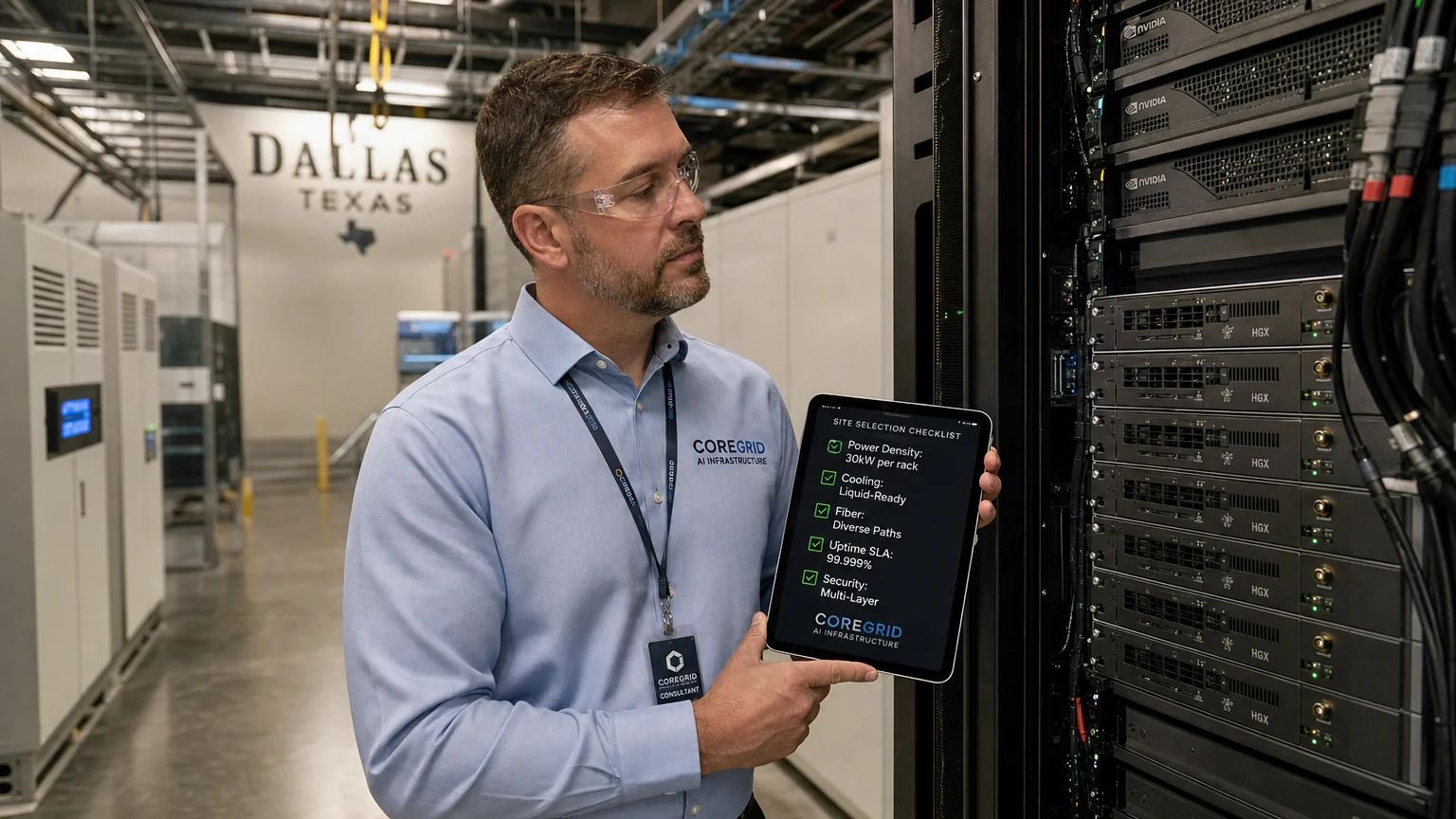
AI Data Center Site Selection in Austin — Infrastructure Planning for High-Density Compute
CoreGrid AI Infrastructure provides AI data center site selection consulting in Austin, helping technology companies, AI startups, and enterprise IT teams identify, compare, and evaluate colocation and infrastructure sites suited to GPU-intensive and high-density workloads. Based in Dallas and actively serving the Austin market, CoreGrid delivers vendor-neutral research, power availability analysis, and written site briefings — so your team can make a confident infrastructure decision before signing a lease or colocation contract.
Ready to evaluate Austin-area data center options? Call (214) 555-0196 or get a free quote to schedule an infrastructure strategy call.
AI Data Center Site Selection in Austin — Quick Facts
| Field | Detail |
|---|---|
| Service | AI data center site selection consulting |
| City | Austin, TX |
| Provider | CoreGrid AI Infrastructure |
| Engagement Start | Scoped on initial strategy call |
| Starting Price | Varies by scope — see pricing section below |
| Areas Served | Austin and surrounding Central Texas region; see full list below |
| Credentials | See “Missing information” block — credentials not yet verified for publication |
| Phone | (214) 555-0196 |
| Last Updated | August 2026 |
Why Growing Companies Choose CoreGrid AI Infrastructure for Austin Site Selection
CoreGrid AI Infrastructure brings 6 years of data center planning experience and a track record spanning 120+ colocation and infrastructure projects reviewed across 18 U.S. markets — including the Austin and broader Texas corridor. The firm has supported more than $420 million in infrastructure decisions, working with AI startups, SaaS companies, cloud teams, enterprise IT departments, and investors evaluating data center expansion.
What distinguishes CoreGrid in Austin engagements is the firm’s vendor-neutral stance. CoreGrid does not own data centers, does not sell colocation space, and does not represent any specific facility provider. Every recommendation is built on research, not referral incentives.
CoreGrid proof points relevant to Austin engagements:
- 6+ years supporting infrastructure planning across major U.S. data center markets
- 120+ data center and colocation projects reviewed
- 18 U.S. data center markets analyzed, including Texas markets
- $420M+ in infrastructure decisions supported
- Clients include AI startups, SaaS companies, cloud teams, enterprise IT, and managed service providers
- Vendor-neutral recommendations — no financial relationship with any colocation provider
- Market-by-market power and capacity research methodology
- AI, inference, and high-density workload planning expertise
For more on the team’s background and approach, visit the about CoreGrid AI Infrastructure page.
Areas We Serve Near Austin
CoreGrid serves clients throughout Austin and the surrounding Central Texas region as part of its broader U.S. service footprint. Austin engagements are supported from the Dallas headquarters, with remote-first delivery and on-site coordination available based on project scope.
Regions and communities served in and around Austin:
- Austin (citywide)
- Round Rock
- Cedar Park
- Pflugerville
- Georgetown
- Kyle and Buda
- San Marcos
- Leander
CoreGrid also serves clients across the full Texas technology corridor — including Dallas-Fort Worth and Houston — and supports multi-city strategy engagements that connect Austin to other U.S. data center markets. See our services for the complete national coverage model.
How Much Does AI Data Center Site Selection Cost in Austin?
AI data center site selection consulting is priced based on engagement scope, not a flat service rate. Because each project involves different workload requirements, numbers of candidate sites, and strategic complexity, CoreGrid scopes and prices engagements individually after an initial discovery call.
The table below outlines qualitative engagement tiers to help you understand what drives cost. Exact pricing requires a direct conversation — call (214) 555-0196 or contact us to get a scoped estimate.
| Engagement Type | Relative Scope | Key Cost Drivers |
|---|---|---|
| Single-market site shortlist (Austin only) | Focused | Number of sites evaluated, power density complexity, turnaround timeline |
| Multi-city strategy (Austin + other markets) | Broader | Number of markets, cross-market redundancy analysis, deliverable depth |
| Ongoing advisory retainer | Extended | Frequency of research updates, number of stakeholders, scope of vendor comparison |
| Specialized assessment (liquid cooling, edge inference) | Technical depth | Workload specificity, facility access requirements, reporting format |
What is typically included in a CoreGrid engagement: Scoped during the discovery call, but generally covers market research, site scoring, power availability review, and a written briefing document. See the “What’s Included” section below for detail.
What is not included: CoreGrid does not provide licensed electrical engineering, utility interconnection services, construction management, legal counsel, or real estate brokerage. See service exclusions below.
When is a custom quote required? Always. There is no published flat rate for site selection consulting because scope varies materially by workload type, number of sites, and strategic complexity.
Is AI data center site selection consulting more expensive in Austin than in other Texas markets?
Engagement pricing reflects project scope and complexity, not geography. An Austin-only single-market shortlist and a Dallas-only shortlist of equivalent scope would be priced similarly. Where Austin engagements can add scope — and therefore cost — is when clients need Austin evaluated as part of a multi-city strategy alongside Dallas-Fort Worth, Houston, or national markets.
Are initial strategy calls or estimates free?
CoreGrid offers an initial infrastructure strategy call to scope your project before any engagement is priced. This call is the appropriate starting point — it allows both parties to confirm fit and establish realistic scope before any commitment is made.
What factors most affect the cost of an Austin site selection engagement?
The primary cost drivers are: the number of candidate sites to evaluate, the technical complexity of your workload (standard colocation vs. high-density GPU vs. liquid-cooled AI clusters), whether Austin is a standalone market or part of a multi-city strategy, and the depth of deliverables required (summary briefing vs. full decision framework with financial modeling inputs).
Common AI Data Center Site Selection Challenges in Austin
Austin presents a distinctive set of infrastructure planning considerations that differ meaningfully from other major U.S. data center markets. Understanding these dynamics before committing to a site is exactly why structured site selection consulting adds value in this market.
Power availability and grid context. Texas operates on an independent power grid (ERCOT), which creates a different power procurement and reliability context than markets tied to PJM or WECC. For AI and GPU workloads — which can draw 50–100+ kW per rack at scale — understanding power headroom, redundancy configuration, and utility feed reliability at a specific Austin-area site is a non-negotiable part of site selection. CoreGrid’s power availability research addresses this directly, though the firm does not provide utility engineering services or guarantee power contracts.
Cooling infrastructure for high-density AI hardware. Modern AI accelerators — including GPU clusters used for training and inference — generate heat densities that exceed the design parameters of many legacy colocation facilities. Austin’s climate, with extended periods of high ambient temperatures, makes cooling infrastructure quality a critical evaluation criterion. CoreGrid’s liquid-cooling readiness assessments help clients identify whether candidate facilities can support direct liquid cooling or immersion cooling before a commitment is made.
Market growth and capacity timing. Austin’s data center market has been expanding, and demand from hyperscale and enterprise AI deployments has tightened available capacity in some segments. Timing matters — a site that shows available capacity today may be committed by the time a lease is executed months later. CoreGrid’s market research helps clients understand current availability and plan realistic timelines.
Proximity to the Dallas-Fort Worth corridor. Austin’s geographic relationship to the Dallas-Fort Worth data center market — one of the largest in the U.S. — creates strategic options for distributed deployments, redundancy planning, and workload segmentation. Clients evaluating Austin should consider whether a single-market or multi-market strategy better fits their resilience and latency requirements. CoreGrid’s multi-city data center strategy work addresses exactly this trade-off.
How does Texas’s independent power grid affect AI data center site selection in Austin?
ERCOT, the grid operator for most of Texas including Austin, operates independently from the Eastern and Western Interconnections. This means power pricing, reserve margins, and grid event risk profiles differ from other U.S. markets. For large AI deployments, understanding how a specific Austin facility is configured for grid reliability — including backup generation, UPS systems, and utility feed redundancy — is an essential part of site due diligence, not an afterthought.
Do Austin data centers support liquid cooling for GPU workloads?
Liquid-cooling readiness varies significantly by facility age, design, and operator investment. Not all Austin-area colocation facilities have been upgraded to support direct liquid cooling or rear-door heat exchangers at the densities required by current-generation AI accelerators. CoreGrid’s liquid-cooling readiness assessments evaluate this capability at the site level so clients are not surprised after signing a contract.
Should an Austin AI deployment be standalone or part of a multi-city strategy?
This depends on your workload’s latency sensitivity, redundancy requirements, and scale trajectory. Austin works well as a standalone market for certain inference and edge workloads, and as a secondary or tertiary node in a multi-city strategy anchored in Dallas-Fort Worth or Northern Virginia. CoreGrid helps clients map this decision before committing to any single site. Explore the multi-city data center strategy service for more detail.
When to Engage CoreGrid for AI Data Center Site Selection in Austin
The right time to start a site selection engagement is before you have a preferred site — not after. Once a team has anchored on a specific facility, the cognitive and organizational cost of changing course is high, and critical trade-offs are often missed.
Engage CoreGrid when:
- Your organization is planning an AI, GPU, or high-performance computing deployment and needs to identify suitable Austin-area colocation capacity
- You are evaluating Austin as one node in a multi-city infrastructure strategy and need a market-level assessment
- Your current facility is approaching power or cooling limits and you need to identify expansion or migration options
- You are an investor or executive evaluating data center market exposure in Austin and need a structured briefing
- Your team lacks in-house expertise to evaluate power density, cooling infrastructure, or carrier connectivity at the site level
This is not a service for:
- Companies that have already signed a colocation contract and need operational support — CoreGrid’s value is in the pre-commitment planning phase
- Organizations seeking licensed electrical engineering, construction management, or legal services — these require separately licensed professionals
Call (214) 555-0196 or read more on our blog about what makes a data center AI-ready before your next infrastructure decision.
How to Choose an AI Data Center Site Selection Consultant in Austin
Selecting the right advisory partner for a data center site selection engagement is itself a decision worth structuring. Use the following checklist when evaluating any consultant — including CoreGrid.
Buyer checklist:
- Vendor neutrality — Does the firm have financial relationships with colocation providers that could bias recommendations? Ask directly.
- Workload-specific expertise — Has the firm worked on AI, GPU, and high-density deployments specifically, or primarily general-purpose IT colocation?
- Market coverage — Does the firm have research depth in Austin and the broader Texas market, or is it applying a generic national template?
- Deliverable clarity — Can the firm describe exactly what you will receive at the end of the engagement — a written report, a scored comparison, a decision framework?
- Scope transparency — Is the firm clear about what it does not do (engineering, brokerage, legal)?
- Pricing model — Is pricing scoped before work begins, or are fees vague until the engagement is underway?
- Track record — Can the firm point to a documented history of infrastructure projects reviewed and decisions supported?
- Accurate contact information — Verify the firm’s NAP (name, address, phone) is consistent across its website, Google Business Profile, and any directory listings. Inconsistent NAP is a basic trust signal failure.
CoreGrid meets these criteria as described on the about CoreGrid AI Infrastructure page. We encourage you to apply this checklist to any firm you evaluate.
Get a Free Strategy Call for Austin AI Data Center Site Selection
CoreGrid AI Infrastructure is ready to help your team evaluate Austin-area data center options for AI, GPU, and high-density compute workloads. The first step is a scoped infrastructure strategy call — no commitment required.
Here’s what happens after you reach out:
- A CoreGrid advisor contacts you within one business day to schedule a discovery call.
- On the call, we discuss your workload type, power density requirements, timeline, and budget parameters.
- We confirm whether an Austin-focused or multi-city engagement is the right scope for your needs.
- You receive a written engagement proposal with scope, deliverables, and timeline before any work begins.
Contact CoreGrid AI Infrastructure:
| Phone | (214) 555-0196 |
| Address | 1722 Routh Street, Suite 900, Dallas, TX 75201 |
| hello@coregridai.com | |
| Service Area | Austin, TX and throughout the U.S. data center markets listed on our services page |
| Google Business Profile | (URL to be added before publishing — see “Missing information” block) |
Contact us to schedule your Austin infrastructure strategy call →
Last updated: August 2026 · Page reviewed by CoreGrid AI Infrastructure editorial team
Frequently Asked Questions
What does AI data center site selection consulting in Austin actually involve?
CoreGrid researches available colocation capacity, power availability, cooling infrastructure, and network access across Austin-area sites, then delivers a scored comparison and written briefing. The goal is to give your team a clear, evidence-based shortlist before you commit to a lease or colocation contract. CoreGrid does not own data centers or act as a broker — the service is purely advisory and vendor-neutral.
Why is Austin a relevant market for AI data center deployments?
Austin sits within a fast-growing Texas technology corridor with expanding power infrastructure and a growing base of enterprise and hyperscale-adjacent colocation providers. Its proximity to the Dallas-Fort Worth market also makes it a strong candidate for distributed or redundant AI deployments. CoreGrid analyzes Austin-area capacity as part of both single-market and multi-city infrastructure strategies.
Does CoreGrid guarantee power availability or colocation capacity in Austin?
No. CoreGrid provides research and planning guidance based on market-sourced information, but cannot guarantee utility power contracts, colocation availability, or GPU capacity on behalf of any provider. All findings are advisory. This distinction is important — any consultant claiming to guarantee power or capacity in Austin should be asked to explain the legal basis for that claim.
How long does an Austin site selection engagement typically take?
Engagement timelines vary based on the number of sites to evaluate, the complexity of your workload requirements, and whether Austin is a standalone market or part of a multi-city strategy. CoreGrid scopes timeline expectations during the initial discovery call before work begins, so you have a realistic delivery window before committing.
Is CoreGrid's site selection advice specific to AI and GPU workloads?
Yes. CoreGrid's planning work is oriented around high-density, power-intensive AI, GPU, and HPC workloads — not general-purpose IT colocation. Power density per rack, cooling infrastructure type, and network latency to inference endpoints are central evaluation criteria in every Austin engagement.
What is the difference between site selection consulting and a real estate broker service?
CoreGrid is an infrastructure planning and advisory firm, not a licensed real estate broker. The company helps you understand technical site requirements, compare facility capabilities, and build a decision framework — it does not execute lease transactions or represent you in contract negotiations with colocation providers or landlords. If you need real estate legal or brokerage services, those require separately licensed professionals.
Can CoreGrid help if Austin is just one part of a larger multi-city deployment?
Yes. CoreGrid supports multi-city data center strategy and has analyzed markets across the United States. If your team needs Austin to work in concert with Dallas, Phoenix, Northern Virginia, or other markets, CoreGrid can map how each site fits into a coherent, redundant infrastructure plan — including workload segmentation, latency zoning, and cost trade-off analysis across markets.