

Both Dallas and Phoenix have emerged as serious contenders for AI data center investment in 2026 — but they serve different deployment profiles, risk tolerances, and growth timelines. This comparison breaks down the key factors that determine which market better fits your AI infrastructure strategy.
Quick Answer
Dallas holds a structural edge for organizations that need deep fiber diversity, a mature colocation ecosystem, and proximity to enterprise demand. Phoenix competes strongly on land availability, lower construction costs, and aggressive utility expansion — making it attractive for hyperscale and greenfield builds. The right choice depends on your workload type, power requirements, and budget horizon.
Key Takeaways
- Dallas offers denser fiber interconnection and a larger existing colocation provider base than Phoenix.
- Phoenix has lower land costs and more available acreage for large-footprint campus builds.
- Both markets face power availability pressure in 2026, but through different utility dynamics.
- Dallas benefits from a larger local AI and tech talent pool for on-site operations teams.
- Phoenix’s desert climate requires more engineered cooling solutions, increasing upfront CapEx.
- Dallas carries some weather risk (severe storms, ice events) that requires redundancy planning.
- For AI inference and GPU colocation, Dallas currently has more immediately available high-density inventory.
- Multi-city strategies that include both markets can reduce single-point risk for enterprise AI deployments.
How Do Dallas and Phoenix Compare as AI Data Center Markets?
Dallas vs Phoenix for AI data center deployment is one of the most frequently analyzed market comparisons in 2026 — and for good reason. Both cities sit outside the historically congested Northern Virginia and Silicon Valley corridors, offer business-friendly regulatory environments, and have attracted significant colocation and hyperscale investment over the past several years.
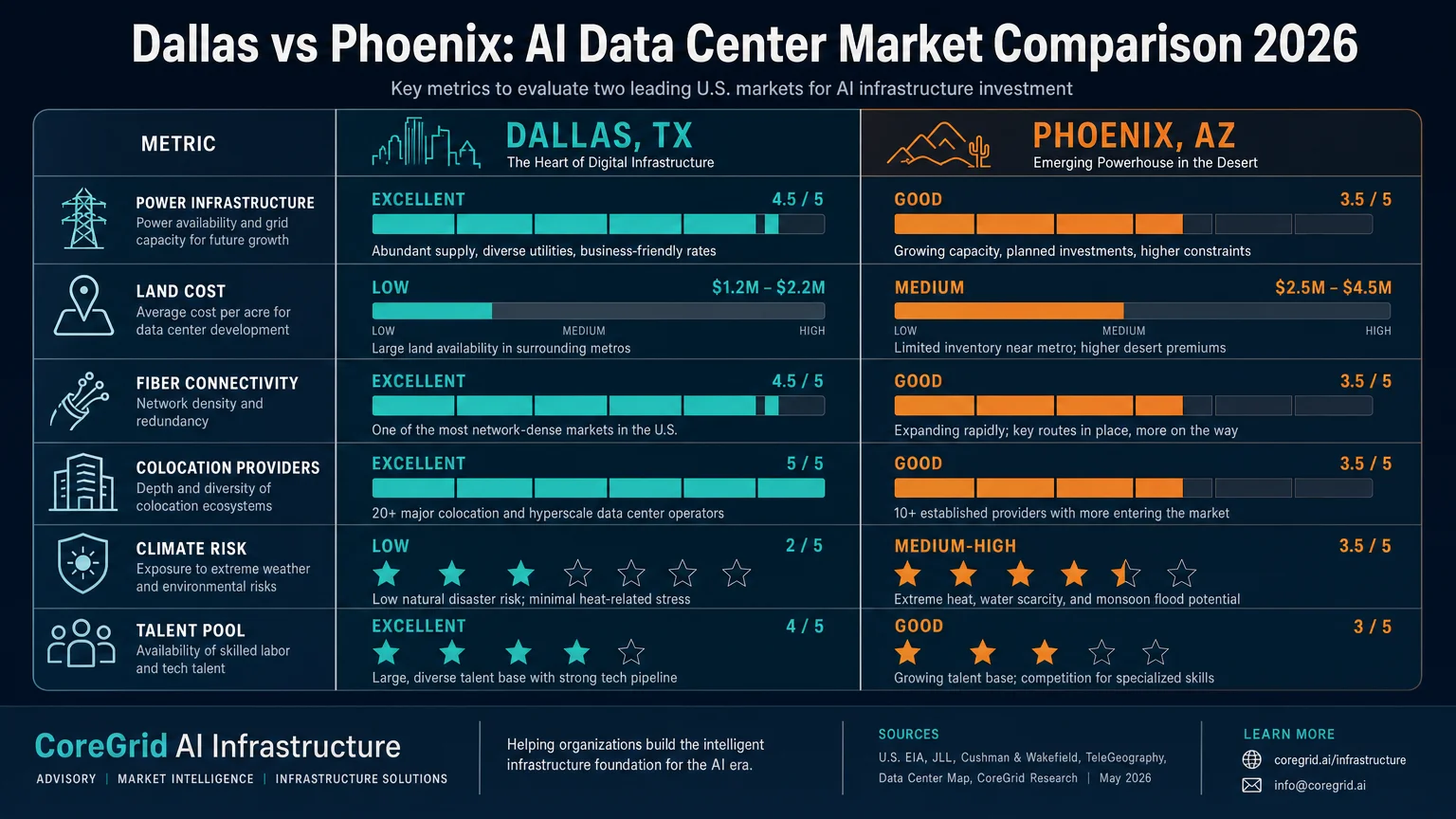
Dallas anchors the DFW metroplex, which has grown into one of the top five U.S. data center markets by total capacity. The region benefits from multiple Tier 1 fiber routes, a high concentration of Fortune 500 corporate headquarters generating local compute demand, and a well-established colocation ecosystem with providers operating across Allen, Garland, Irving, and downtown Dallas. Phoenix, by contrast, has grown rapidly from a secondary market into a genuine Tier 1 contender, driven by land availability, lower property taxes than coastal markets, and utility investments from Salt River Project and APS. For AI workloads specifically, the question is not which city is “better” in the abstract — it is which market aligns with your deployment timeline, density requirements, and operational model.
What Does Power Availability Look Like in Each Market?
Power is the single most constrained resource for AI data center deployment in 2026, and both Dallas and Phoenix are navigating that constraint differently.
In Dallas, power is delivered primarily through Oncor’s transmission infrastructure within the ERCOT grid. ERCOT’s deregulated structure gives operators more flexibility in energy procurement and rate negotiation, but it also means that large power requests — particularly those above 20 MW — require careful queue management and interconnection planning. The grid has faced reliability scrutiny since 2021, and any serious deployment plan should include redundancy and backup generation analysis as a baseline.
Phoenix operates within a regulated utility environment through APS and SRP. These utilities have been investing in transmission capacity to accommodate data center load growth, and the regulated structure can offer more predictable long-term rate frameworks. However, Phoenix’s rapid data center expansion has created its own power queue pressure, and securing large blocks of power on short timelines is not guaranteed in either market.
Power Comparison Summary
| Factor | Dallas (ERCOT) | Phoenix (APS/SRP) |
|---|---|---|
| Grid structure | Deregulated | Regulated |
| Rate flexibility | Higher | More predictable |
| Large-block availability | Competitive queue | Competitive queue |
| Renewable energy access | Strong wind/solar mix | Strong solar access |
| Backup generation norms | Required for AI density | Required for AI density |
Which Market Offers Better Fiber and Connectivity Infrastructure?
Dallas has a clear advantage in fiber density and carrier diversity. The DFW region sits at the intersection of multiple long-haul fiber routes connecting the East and West coasts, with major carrier hotels and meet-me rooms providing access to dozens of network providers. For AI inference workloads that require low-latency connectivity to end users across the central U.S., Dallas’s geographic position is genuinely strategic.
Phoenix has improved its connectivity profile significantly, with several major fiber providers building out routes along the I-10 and I-17 corridors. For organizations deploying AI training workloads — where latency to end users matters less than raw compute throughput — Phoenix’s connectivity is adequate. However, for inference-heavy applications or hybrid cloud architectures requiring diverse carrier options, Dallas still offers more options at competitive pricing.
If your AI infrastructure strategy involves AI data center site selection across multiple cities, fiber path diversity between your primary and secondary sites should factor heavily into the comparison.
How Do Colocation Options and Inventory Compare?
Dallas has a larger and more mature colocation market, with established providers operating multi-campus footprints across the metroplex. This translates to more available inventory for immediate deployment, more competitive pricing pressure between providers, and more options for high-density AI configurations in the 20–40 kW per rack range.
Phoenix has attracted major colocation investment, and several large campuses are either operational or under construction as of 2026. The challenge for AI-specific deployments is that much of Phoenix’s new capacity is designed for hyperscale cloud customers with different density profiles than GPU inference clusters. Organizations looking for purpose-built AI colocation with liquid-cooling readiness may find more immediately deployable options in Dallas.
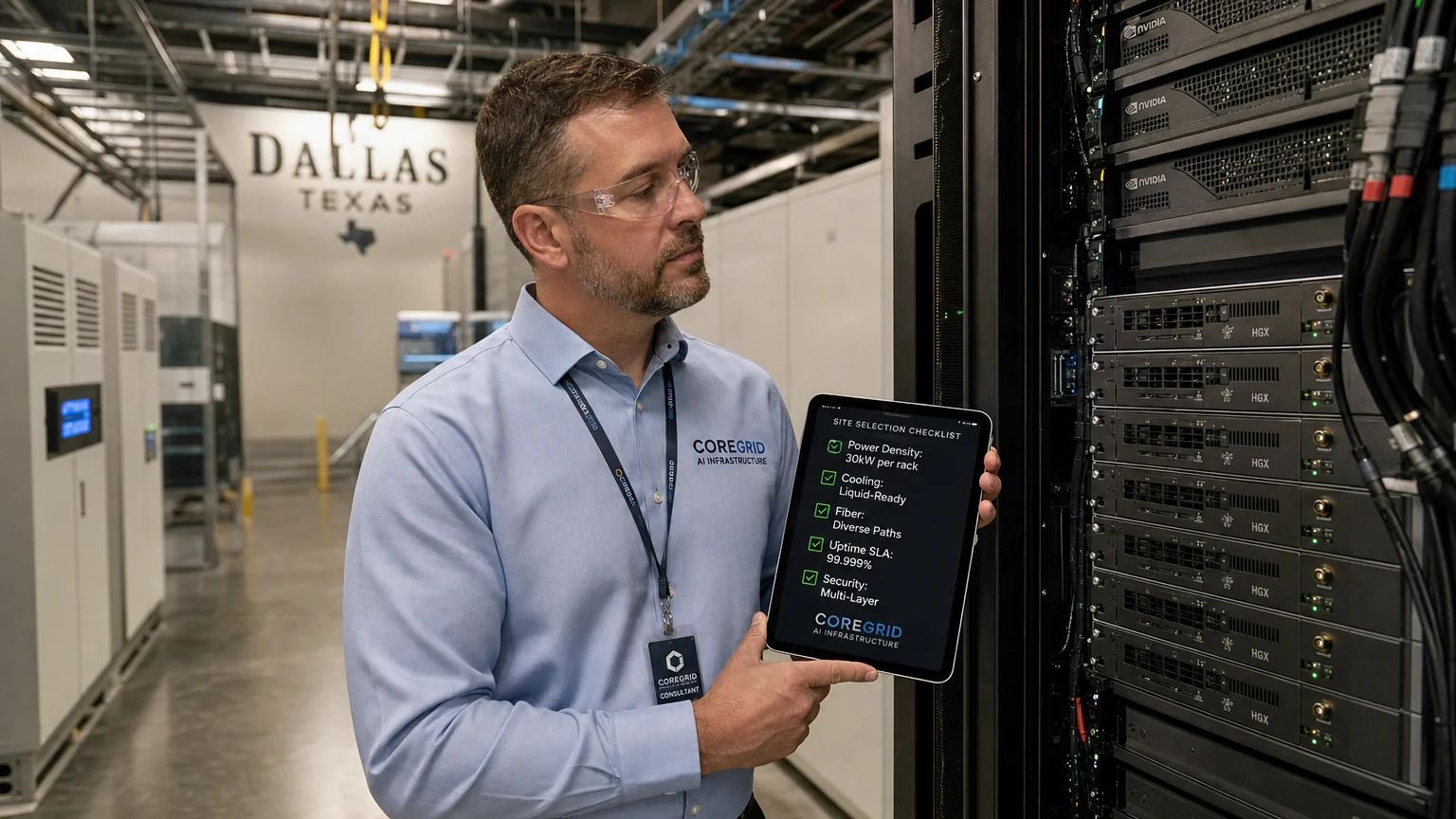
For teams evaluating AI data center site selection in Dallas, the local colocation market offers the advantage of established relationships, competitive SLA benchmarks, and a track record of supporting high-density GPU deployments. Phoenix remains a strong option for organizations with longer build timelines and larger footprint requirements.
What Are the Climate and Operational Risk Profiles?
This is where the two markets diverge most sharply in character, even if neither is definitively “safer.”
Dallas faces weather-related risks including severe thunderstorms, occasional ice storms, and the documented grid stress events that have affected ERCOT during extreme temperature periods. These risks are manageable with proper redundancy design — N+1 or 2N power configurations, robust UPS systems, and generator capacity — but they must be planned for explicitly, not assumed away.
Phoenix faces a different risk profile centered on extreme heat. Ambient temperatures regularly exceed 110°F in summer months, which places significant stress on cooling systems and increases cooling energy costs. Air-side economization — common in cooler climates — has limited applicability in Phoenix during peak summer. This makes liquid cooling infrastructure more operationally critical in Phoenix than in Dallas, and it increases the CapEx required to build a thermally resilient AI facility. Teams conducting high-density rack planning for GPU clusters should model Phoenix cooling costs carefully before committing to a site.
Which Market Is Better for AI Talent and Operations Teams?
Dallas has a larger technology workforce and a more developed AI ecosystem, supported by major universities, a growing startup community, and the presence of large enterprise technology buyers. For organizations that need to staff on-site operations, field engineers, or AI infrastructure teams locally, the DFW talent pool is a meaningful operational advantage.
Phoenix has a growing technology sector, supported by Arizona State University’s engineering programs and an expanding base of technology employers. For remote-managed or minimally staffed colocation deployments, the talent differential matters less. But for organizations building out managed AI infrastructure operations, Dallas currently offers more depth in the local labor market.
Dallas vs Phoenix: Side-by-Side Decision Framework
| Deployment Profile | Recommended Market |
|---|---|
| AI inference with low-latency requirements | Dallas |
| Large-footprint GPU training campus | Phoenix (longer timeline) |
| Immediate high-density colocation | Dallas |
| Greenfield build with cost-sensitive CapEx | Phoenix |
| Multi-carrier fiber diversity required | Dallas |
| Regulated utility rate predictability preferred | Phoenix |
| On-site operations team required | Dallas |
| Hyperscale or wholesale lease model | Either (Phoenix slight edge on land) |
Should You Consider a Multi-City Strategy?
For enterprise AI deployments with redundancy requirements, the most defensible answer to the Dallas vs Phoenix question is often “both.” A primary deployment in Dallas — leveraging its fiber density, colocation maturity, and talent base — paired with a secondary or disaster recovery footprint in Phoenix provides geographic separation, utility diversity, and workload flexibility.
CoreGrid AI Infrastructure has supported AI data center site selection across 18 U.S. markets, and multi-city strategies are increasingly common among AI-native companies and enterprise IT teams managing GPU clusters at scale. If you are evaluating a multi-region approach, the planning considerations extend well beyond individual market comparisons — power queue timing, cross-site latency, and colocation contract structures all require coordinated analysis.
Making the Right Call for Your AI Infrastructure
The Dallas vs Phoenix comparison for AI data center deployment does not have a universal winner — it has a right answer for each specific deployment profile, budget, and timeline. Dallas leads on fiber diversity, colocation maturity, and immediate high-density availability. Phoenix leads on land cost, campus scale potential, and regulated utility predictability.
CoreGrid AI Infrastructure has spent six years helping AI startups, enterprise IT teams, and cloud operators work through exactly these decisions across 18 U.S. markets, supporting over $420M in infrastructure planning decisions. If you are evaluating Dallas, Phoenix, or a multi-city strategy for your next AI deployment, the next step is a structured infrastructure strategy conversation — not a generic RFP.
Book an Infrastructure Strategy Call with the CoreGrid team to get a vendor-neutral market comparison tailored to your workload requirements, power needs, and deployment timeline.
Frequently Asked Questions
Is Dallas or Phoenix cheaper for AI data center colocation in 2026?
Phoenix generally offers lower land and construction costs for new builds, which can reduce CapEx for greenfield projects. Dallas typically offers more competitive colocation pricing due to higher provider density and market competition, particularly for immediate deployments in the 1–5 MW range.
Which city has better power reliability for AI workloads?
Neither market guarantees power reliability without proper redundancy design. Dallas operates on ERCOT, which has faced stress events during extreme weather. Phoenix operates on regulated utilities with ongoing capacity investment. Both markets require N+1 or higher redundancy configurations for mission-critical AI infrastructure.
Can CoreGrid AI Infrastructure help with site selection in both markets?
Yes. CoreGrid supports [AI data center site selection in Dallas](/ai-data-center-site-selection-in-dallas) as well as Phoenix, and can provide vendor-neutral market comparisons, colocation provider reviews, and power availability research for both cities as part of a broader infrastructure strategy engagement.
How does Phoenix's heat affect AI data center cooling costs?
Phoenix's extreme summer temperatures limit the effectiveness of air-side economization and increase cooling energy consumption significantly. Liquid-cooled or hybrid cooling architectures are more operationally appropriate for high-density AI deployments in Phoenix, which increases upfront infrastructure investment compared to cooler-climate markets.
What power density should I plan for AI GPU deployments?
Modern AI GPU clusters — particularly those using H100 or next-generation accelerators — commonly require 20–40 kW per rack or higher. Both Dallas and Phoenix colocation providers are building out high-density capabilities, but availability varies by facility and requires direct verification during the site selection process.
Is Phoenix a Tier 1 data center market in 2026?
Phoenix is widely recognized as a Tier 1 U.S. data center market in 2026, having grown significantly from its secondary-market status earlier in the decade. It hosts major colocation campuses and hyperscale deployments, though its colocation inventory profile differs from Dallas in density and immediate availability.
What is the biggest mistake companies make when choosing between Dallas and Phoenix?
The most common error is selecting a market based on headline cost comparisons without accounting for total cost of deployment — including cooling infrastructure, power redundancy, connectivity costs, and operational staffing. A lower land cost in Phoenix can be offset by higher cooling CapEx and longer power queue timelines if those factors are not modeled in advance.
Contributing writer at CoreGrid AI Infrastructure.