
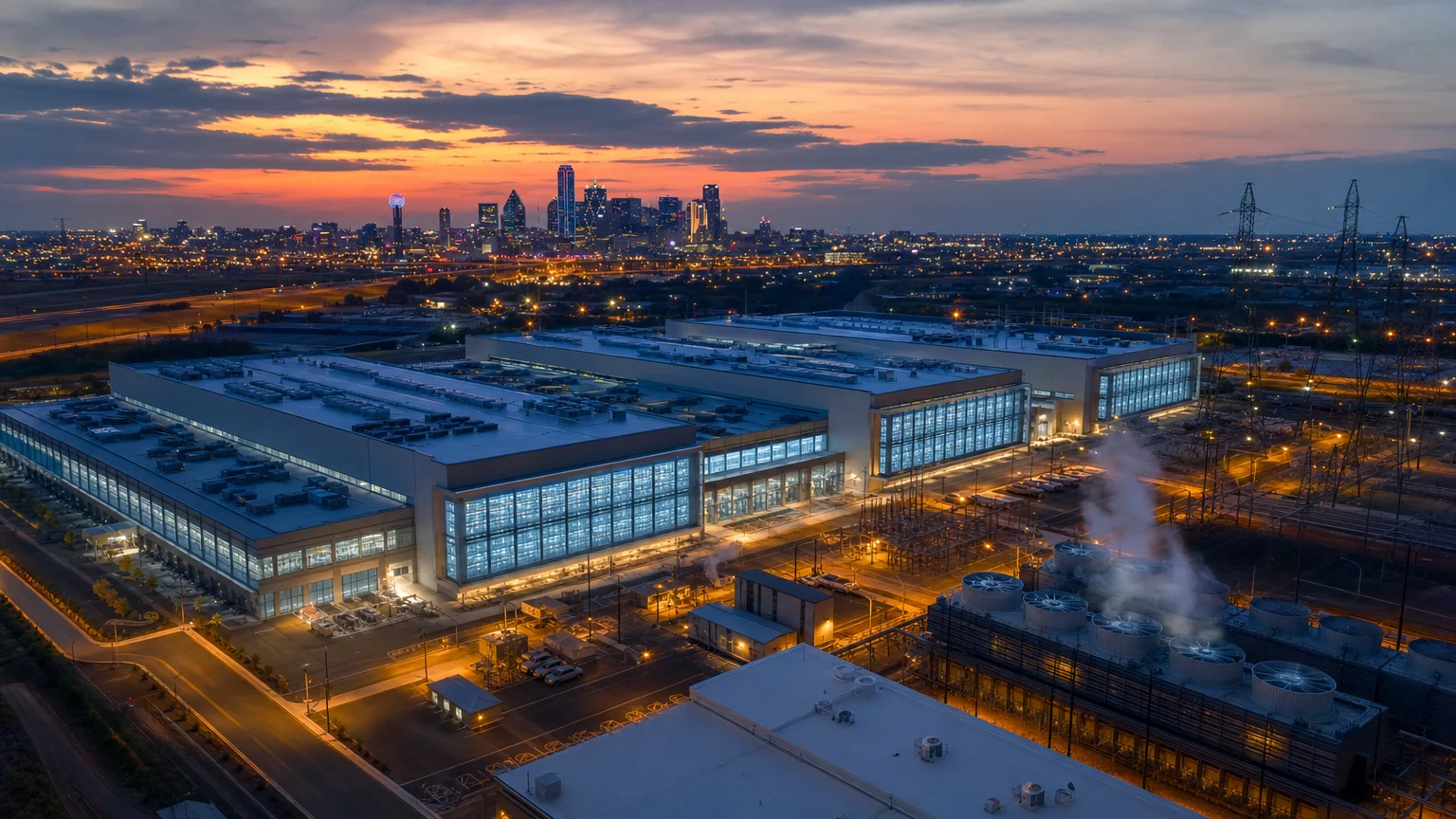
Roughly 80% of data center projects that run over budget cite poor site selection as a contributing factor, according to infrastructure planning research published by Uptime Institute. Choosing the wrong location — or committing to a facility before validating its power, cooling, and connectivity profile — can cost organizations millions in remediation, migration, and lost compute time. This AI data center site selection checklist is designed to help infrastructure teams, AI startups, and enterprise IT leaders work through every critical variable before signing a colocation agreement or deploying GPU hardware.
Key Takeaways
- Site selection for AI workloads requires a fundamentally different checklist than traditional enterprise IT deployments — power density, cooling method, and latency tolerance are non-negotiable starting points.
- Power availability is consistently the most constrained resource in high-demand U.S. markets; verify utility capacity before any other commitment.
- Cooling infrastructure must match your GPU rack density — air cooling is often insufficient for modern AI clusters exceeding 20–30 kW per rack.
- Physical risk factors (flood zones, seismic activity, severe weather corridors) belong in every site evaluation, not just enterprise-scale projects.
- Total cost of ownership across a 3–5 year horizon is a more reliable decision metric than headline colocation pricing.
- Markets like Dallas, Phoenix, Atlanta, and Columbus offer meaningful advantages for AI workloads compared to capacity-constrained legacy markets.
- Vendor-neutral site evaluation produces better outcomes than relying solely on a colocation provider’s own marketing materials.
What Makes AI Data Center Site Selection Different from Traditional IT?
AI workloads — particularly GPU-dense training and inference clusters — impose physical and electrical demands that standard enterprise IT facilities were never designed to handle. A traditional server deployment might draw 5–8 kW per rack. A modern AI training cluster can exceed 80–100 kW per rack when using high-end GPU hardware. That gap changes everything: power delivery architecture, cooling system design, structural floor loading, and even the physical footprint of a facility all need to be re-evaluated.
The step-by-step checklist in this guide is structured around those differences. Each section addresses a specific decision gate — a point where an underprepared team might proceed without adequate information and pay for it later.
Step 1: Define Your Workload Requirements Before Evaluating Any Site
The first step in any professional AI data center site selection process is internal, not external. Before contacting a single colocation provider or reviewing a single market, document your actual workload profile.
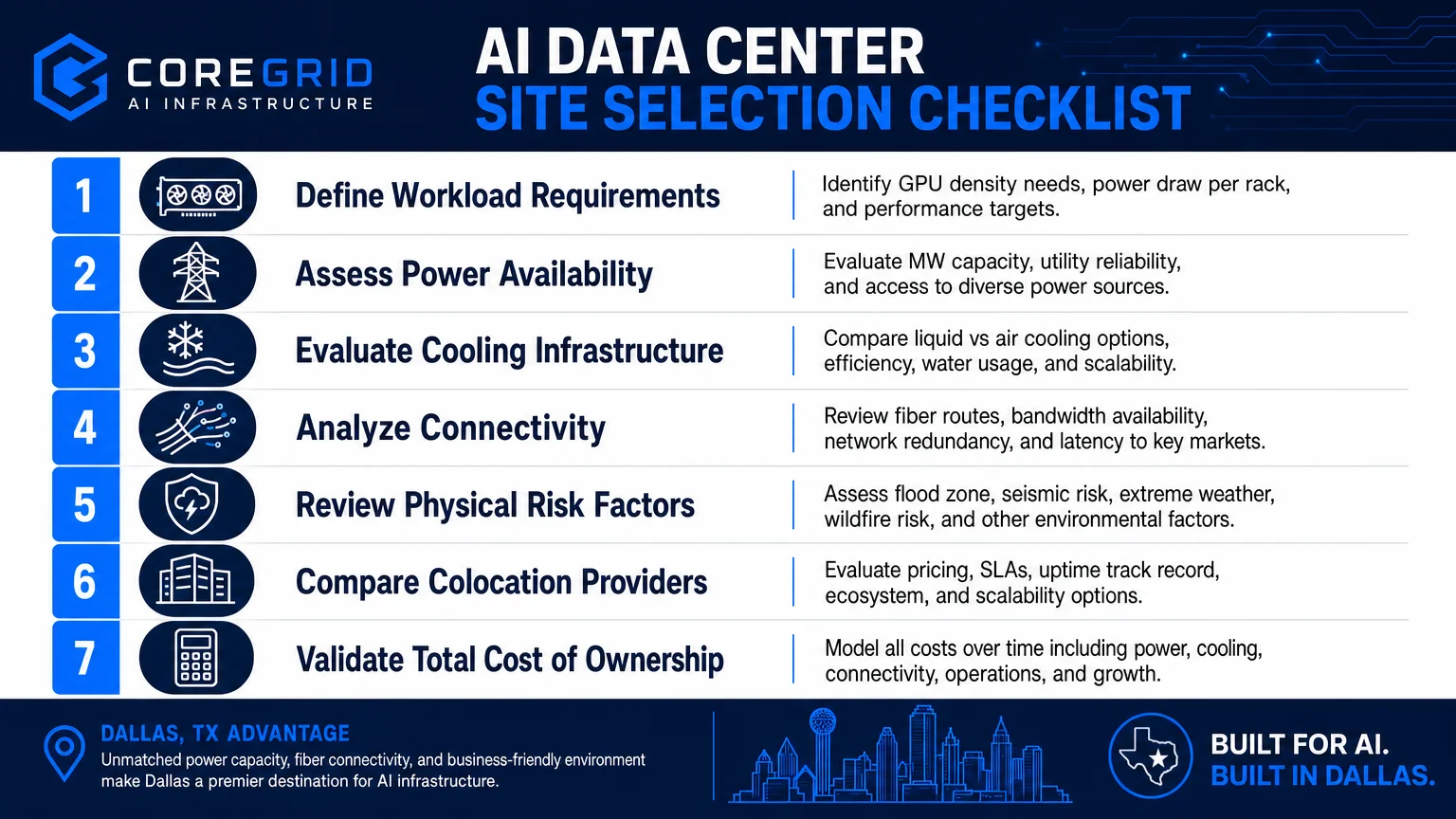
Key questions to answer at this stage:
- GPU density per rack: How many GPUs per server, and how many servers per rack? This determines your kW-per-rack requirement.
- Total power draw: What is your projected power envelope at launch, and what is your 18–36 month growth trajectory?
- Latency sensitivity: Are your workloads latency-sensitive (real-time inference, edge applications) or latency-tolerant (batch training)?
- Redundancy requirements: Do you need N+1 or 2N power and cooling redundancy, or is a lower redundancy tier acceptable for cost reasons?
- Compliance obligations: Do your workloads involve regulated data (HIPAA, FedRAMP, SOC 2) that constrains facility selection?
Skipping this step leads to one of the most common and costly mistakes in AI infrastructure planning: evaluating facilities based on price before understanding whether those facilities can physically support your workload.
Step 2: How Do You Assess Power Availability for AI Infrastructure?
Power availability is the single most constrained resource in U.S. data center markets in 2026. Northern Virginia, Silicon Valley, and parts of the Pacific Northwest have seen multi-year queues for new power capacity. Markets like Dallas-Fort Worth, Columbus, Atlanta, and Phoenix have maintained stronger near-term power availability — one reason those markets have attracted significant AI infrastructure investment.
When evaluating a site’s power profile, verify the following:
| Factor | What to Check |
|---|---|
| Utility substation capacity | Available MW at the substation serving the facility |
| Time-to-power | How quickly can contracted power be energized? |
| Redundant utility feeds | Are there two independent utility feeds to the facility? |
| Generator backup | Diesel or gas backup capacity and runtime |
| Power pricing | $/kWh rate and any demand charge structure |
| Scalability | Can power capacity grow with your deployment? |
CoreGrid’s AI data center site selection practice includes market-by-market power availability research across 18 U.S. markets — a critical input for teams that cannot afford to discover power constraints after signing a lease.
Step 3: What Cooling Infrastructure Does an AI Workload Actually Need?
Air cooling — the standard for most enterprise IT deployments — is frequently inadequate for AI rack densities above 20–30 kW. Modern GPU clusters routinely exceed that threshold, and next-generation hardware pushes requirements higher still. Choosing a facility without validating its cooling architecture is one of the fastest ways to strand expensive hardware.
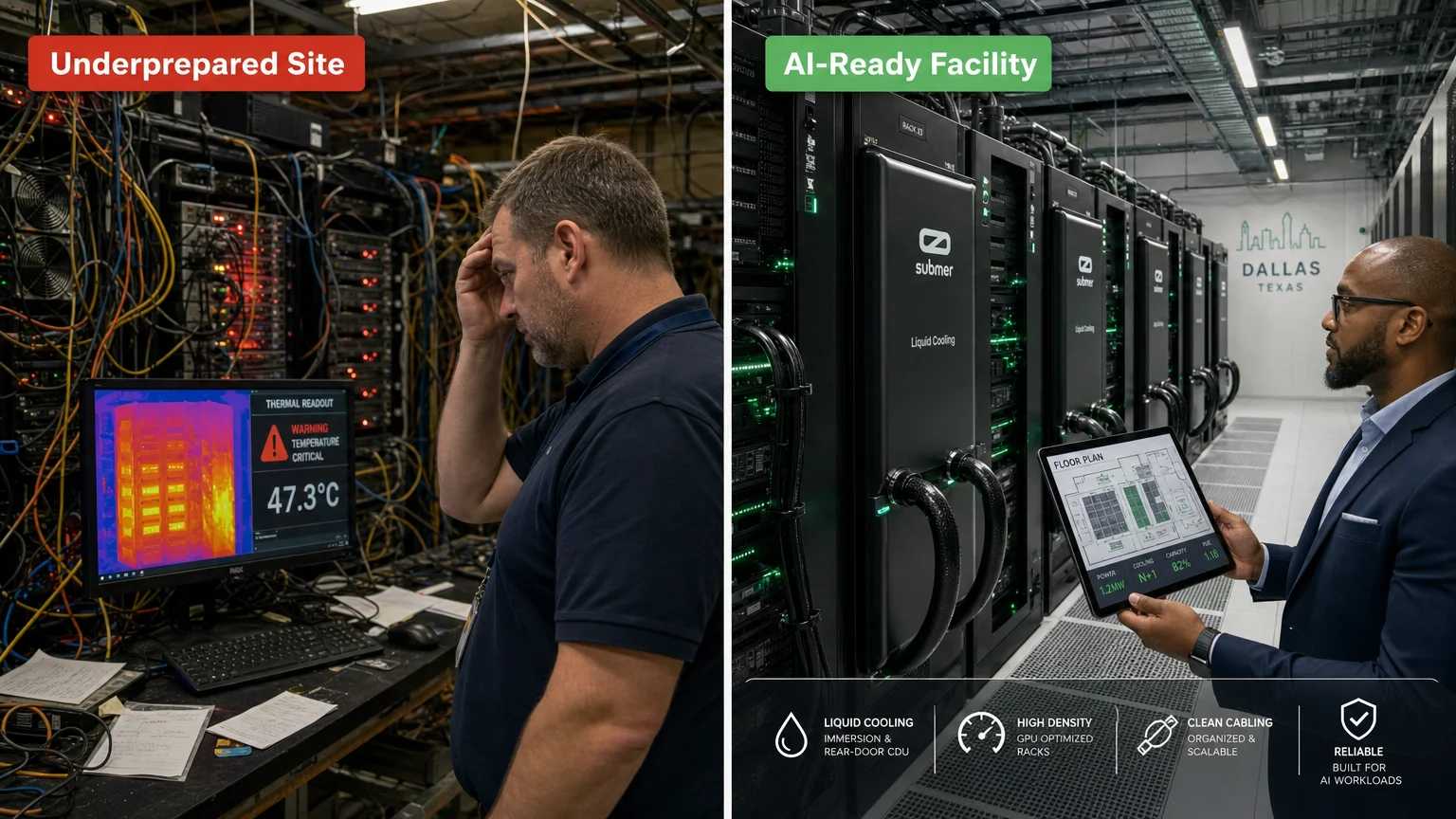
The three cooling approaches most relevant to AI workloads are:
- Precision air cooling (CRAC/CRAH): Viable for moderate-density deployments. Ceiling at roughly 20–25 kW per rack in most implementations.
- Rear-door heat exchangers: Extend air cooling viability to approximately 30–40 kW per rack. Lower infrastructure cost than full liquid cooling.
- Direct liquid cooling (DLC) or immersion cooling: Required for high-density AI clusters. Supports 50–100+ kW per rack. Not available at all facilities.
Before selecting any site, confirm in writing whether the facility supports liquid cooling — and if so, whether it is already installed or requires a build-out timeline. Teams deploying in the Dallas-Fort Worth market can review CoreGrid’s AI data center site selection in Dallas resources for facility-specific guidance.
Step 4: How Should You Evaluate Connectivity and Network Infrastructure?
Connectivity requirements for AI workloads vary significantly by use case. Training clusters that process data in-place have different network demands than inference infrastructure serving end-user applications with latency requirements.
Evaluate the following at every candidate site:
- Fiber diversity: Are there multiple fiber providers entering the building through physically diverse conduit paths?
- On-net carriers: Which Tier 1 and regional carriers are already present in the facility?
- Latency to key endpoints: What is the round-trip latency to your primary cloud regions, customer bases, or data sources?
- Cross-connect pricing: Facilities with high cross-connect fees can significantly inflate total cost of ownership over a multi-year term.
For teams planning AI server deployment planning across multiple markets, connectivity benchmarking should be standardized across all candidate sites before any shortlisting decision.
Step 5: What Physical Risk Factors Belong in a Site Selection Checklist?
Physical risk is often underweighted in AI infrastructure planning — particularly by teams focused primarily on cost and speed-to-deploy. A site in a flood-prone area, a seismically active zone, or a severe weather corridor introduces operational risk that no SLA can fully offset.
Evaluate each candidate site against:
- FEMA flood zone designation: Is the facility in a 100-year or 500-year flood plain?
- Seismic risk: Relevant primarily in California, Pacific Northwest, and parts of the Mountain West.
- Severe weather exposure: Tornado corridors (relevant in parts of Texas and the Midwest), hurricane risk (Gulf Coast, Atlantic seaboard), and wildfire proximity.
- Physical security: Perimeter controls, access management, and proximity to high-traffic or high-crime areas.
Dallas-Fort Worth scores favorably on several of these dimensions — lower seismic risk, no hurricane exposure, and a mature physical security ecosystem among established colocation providers.
Step 6: How Do You Compare Colocation Providers Without Bias?
The colocation market is not transparent by default. Providers present their facilities in the best possible light, and pricing structures — power density limits, cross-connect fees, remote hands rates, and escalation clauses — can obscure true cost comparisons.
A vendor-neutral evaluation process should include:
- Standardized RFP documentation sent to all candidate providers
- Apples-to-apples power cost comparison ($/kW/month, not just $/rack/month)
- Review of contract terms including renewal escalation, exit provisions, and SLA remedies
- Reference checks with existing tenants at similar density profiles
- Physical site visit before any commitment
Teams evaluating multiple markets can reference CoreGrid’s AI data center site selection in Austin and AI data center site selection in Houston pages for regional provider landscape context.
Step 7: How Do You Calculate Total Cost of Ownership for a Data Center Site?
Headline colocation pricing — often quoted as a monthly rack rate — rarely reflects true cost. A complete TCO model for a 3–5 year AI infrastructure deployment should account for:
| Cost Category | Typical Variables |
|---|---|
| Power (metered) | kWh consumption × $/kWh rate |
| Power (contracted) | Reserved kW capacity charges |
| Cooling surcharges | Liquid cooling build-out or premium |
| Cross-connects | Per-port monthly fees |
| Remote hands | Hourly or bundled service rates |
| Contract escalations | Annual % increase clauses |
| Migration costs | One-time move-in and cabling costs |
| Redundancy premium | Cost of N+1 vs. 2N configurations |
Running this model across two or three finalist sites often reveals that the lowest-quoted facility is not the lowest-cost option over a realistic deployment horizon.
Start Your Site Selection Process with a Clear Plan
Selecting the right site for AI infrastructure is a high-stakes decision with long-term cost and performance consequences. The checklist above — covering workload definition, power assessment, cooling validation, connectivity review, physical risk analysis, provider comparison, and TCO modeling — gives infrastructure teams a structured framework for making that decision with confidence.
CoreGrid AI Infrastructure has supported more than 120 data center and colocation projects across 18 U.S. markets, with particular depth in the Dallas-Fort Worth region and major AI infrastructure corridors nationwide. If your team is working through a site selection process and wants a vendor-neutral perspective, book an infrastructure strategy call or visit our AI data center site selection page to learn more about how CoreGrid approaches each evaluation.
Frequently Asked Questions
What is the most important factor in AI data center site selection?
Power availability is consistently the most critical factor for AI workloads. Without sufficient, reliable power capacity at the right density, no other facility attribute matters. Verify utility capacity, substation headroom, and time-to-power before advancing any site through the evaluation process.
How is AI data center site selection different from standard colocation selection?
AI workloads require significantly higher power density per rack, specialized cooling infrastructure (often liquid cooling), and more rigorous network latency analysis than standard enterprise IT. A facility that works well for traditional servers may be physically incapable of supporting a GPU cluster.
What U.S. markets are best for AI data center deployments in 2026?
Dallas-Fort Worth, Phoenix, Atlanta, Columbus, and Northern Virginia are among the most active markets for AI infrastructure in 2026. Each offers different trade-offs in power availability, cost, connectivity, and physical risk profile. Market selection should follow workload requirements, not geographic preference alone.
Does CoreGrid own or operate data centers?
No. CoreGrid AI Infrastructure is a consulting and planning firm. The company helps clients evaluate sites, compare colocation providers, and plan infrastructure deployments — but does not own, operate, or lease data center space directly.
How long does a professional site selection process typically take?
A thorough site selection process — from workload definition through signed agreement — typically takes 8–16 weeks for mid-scale AI deployments. Compressed timelines are possible but increase the risk of missing critical evaluation steps, particularly around power and cooling validation.
Can CoreGrid help with site selection outside of Dallas?
Yes. CoreGrid supports infrastructure planning across 18 U.S. data center markets, including Austin, Houston, Phoenix, Atlanta, Northern Virginia, Chicago, Columbus, Las Vegas, Salt Lake City, Denver, New York Metro, Los Angeles, San Jose, Seattle, and Miami.
What should be in an AI data center site selection RFP?
A strong RFP should specify your power requirements (kW per rack and total MW), cooling method preferences, redundancy tier requirements, connectivity needs, contract term length, and any compliance constraints. Standardizing these inputs across all providers makes comparison meaningful.
Contributing writer at CoreGrid AI Infrastructure.